How to Design a Survey: 9 Steps and One Worked Example
Say a community sports club with about 400 members has room for up to two new classes next season and three possible times: weekdays at 6:30 am, weekdays at 8 pm and Sundays at 4 pm. A survey can tell the club which times people would really come to, or it can produce a pile of opinions nobody acts on. The difference is made before the first question is written. This guide follows the club from that decision to the timetable it trials; clicking through a survey builder is a separate topic.

1. Write down the decision, not the topic
Weak survey design usually starts from a topic, such as find out what members think about the timetable. A topic lets every question in, because everything is about the timetable. A decision lets in only the questions that can change it.
- Topic. Learn what members think about our class times. Anything fits, so nothing gets cut.
- Decision. Choose up to two of three candidate times to trial next season, and check whether a new time would bring back members who left. Now each question either helps choose a time or it goes.
Then write the action rule before you collect a single answer. The club's rule: trial each time that at least 40 people say they would book at least twice a month, up to two times; if more than two clear the bar, trial the two with the most people; keep a time on the timetable only if real bookings confirm it. The club picked 40 as the number that makes a class worth running. A rule written in advance stops the team from reading the results to fit what it already wanted, and it tells you which number each question must produce.
2. List what you need to learn and who can tell you
Break the decision into unknowns. For the club there are four.
- Which new times people would actually book, and how often.
- What could keep them from coming next season.
- Whether people who left in the past year would come back for a new time.
- Whether parents booking for children need different times from adults booking for themselves.
Each unknown points to the people who hold the answer, and here is the trap. Surveying only current members asks the people the present timetable already suits. Those who left because nothing fitted their week, and those on the waiting list, know most about unknowns 2 and 3. So the club invites three groups: current members, members who left in the last 12 months and the waiting list. A former member can also be on the waiting list, so the club merges the lists and sends one invitation per person. If you cannot reach a group, write down that the result does not speak for it.
3. Draft the questions, then cut
Draft freely: write as many questions as you need, one or more for each unknown. Then cut with one test: could this answer change the decision or the route someone takes through the survey? How did you hear about the club? is a fine marketing question, but no answer to it changes which time gets trialled, so it leaves this survey. An age question goes too, because the club has no plan to compare age groups.
- Unknown 1. Which of these new classes would you book at least twice a month? and How many club classes did you attend in the past 7 days?
- Unknown 2. What, if anything, could keep you from attending a class next season?
- Unknown 3. How likely are you to rejoin if one of these times is added? Asked only of former members who chose a time.
- Unknown 4. Who would attend the classes you book?
- Support. A question about how each person relates to the club, which sends them down the right route; one about how well the current timetable fits; one optional open question for anything the list missed.
Questions to ask in a questionnaire, by goal
The same cut works for any survey. Most good survey questions serve one of five goals, and naming the goal tells you what to ask and what kind of answer you need. Two examples for each, from different kinds of surveys.
- Satisfaction. How satisfied are you with today's workshop? · How well does the app meet your needs?
- Behaviour. In the past 30 days, how many times did you order from us? · How many hours a week do you spend preparing lessons?
- Needs. What were you trying to do on our site today? · What is the hardest part of organizing volunteer shifts?
- Priorities. Rank these five features from most to least useful. · What one change would make next year's conference better?
- Audience profile. What is your age group? · How long have you been following the channel?
Each line is a starting point, not a finished survey. More than a hundred worded examples with answer options, grouped by goal and by format, are in our collection of sample survey questions.
4. Word each question so everyone reads it the same way
Neutral words, one idea per question and a fixed time frame help everyone read a question the same way; that is what people mean by objective survey questions. Here are the club's first drafts, the problem in each and the fix.
- Leading. How much would you enjoy our new early-morning class? → How likely are you to book a class on weekdays at 6:30 am? The first version assumes enjoyment and only asks how much.
- Loaded. Should the club finally fix its inconvenient timetable? → How well does the current timetable fit your week? The words finally and inconvenient hand people both the answer and a grievance.
- Double-barreled. Are the class times and the coaching good? → How well do the class times fit your week? and, separately, How would you rate the coaching? A no to the first version cannot tell you which one to change.
- Vague time frame. Do you train often? → How many club classes did you attend in the past 7 days? Often means twice a week to one person and every day to another.
- Jargon. Would you book an off-peak HIIT slot? → Would you book a 45-minute high-intensity class on weekdays at 2 pm? Coaches know the terms; former members and parents may not.
- Absolute words. Do you always train on weekends? → On how many weekends in the past month did you train? Always and never force a yes or no where the truth is a count.
- Negative wording. The timetable is not inconvenient for me. → The timetable is convenient for me. A double negative makes people reverse the scale in their head, and some reverse it wrongly.
- Missing options. Who do you book classes for? Myself · My child → add Someone else and I don't book classes. A person with no fitting option either quits or picks a wrong one.
A question about two things is hard to answer and its results are hard to read, and statements to agree with pull some people toward agree whatever they say. Both effects are described, with tested examples, in the Pew Research Center guide to writing survey questions.
If the draft is in Pollsar, ask the AI assistant to review it. It checks the survey for bias, leading and double-barreled questions and suggests other wording you can accept or change.
5. Choose answer formats you can count
The answer format decides which number you get, so pick it from the action rule. The club needs a count of people for each time, and one person can come to more than one, so the main question lets people choose several times, with None of these as an answer on its own. If you also need each person's first choice, add Which of these would you book first? A ranking puts the times in order but does not tell you how many people would come. One line for each common format:
- Yes/No for a fact with two outcomes and for sending people to the right questions.
- Multiple choice when several answers can be true at once, as with the club's times.
- Numeric for a count typed as a number. In Pollsar a Numeric question always holds a value, so it cannot be left blank; when people may not know or may prefer to skip, use single choice with ranges, as the club does for visits.
- Single choice when the options exclude each other. They must not overlap and must cover everyone, so add Other or None where the list may be incomplete; the article on multiple choice survey questions shows how.
- Ranking when you can act on only one or two options and need a forced order; how to read the results is in the guide to ranking questions in a survey.
- Rating or Likert scale for degree: satisfaction, agreement, likelihood. Wording and labels for every point are covered in Likert scale questions.
- Open-ended for reasons and words you did not foresee. One or two per survey keeps the reading manageable; open-ended questions explains how to sort the answers.
6. Order questions as a funnel
Question order changes answers. An early question sets the context for the ones after it, and a tiring block in the middle makes people quit or click anything. For most surveys the order that works is a funnel, from easy and general to specific and personal.
- Start easy and on topic. The first question should take seconds and clearly match what the invitation promised. Do not open with a request for a name or an email.
- Ask the deciding question early. Put the question the decision depends on right after the warm-up, while attention is fresh and before anyone drops out.
- Go from general to specific. Ask how the timetable fits overall before asking about new times, so the specific question does not color the general one.
- Keep topics together. Questions about one subject sit in one block; a short heading helps when the survey changes subject.
- Put sensitive and demographic questions last. Pew advises against asking about income, education or age near the beginning unless you need them to check eligibility or route people. By the end, people know why you ask.
- Keep scales in one direction. If the first scale runs from negative to positive, every scale should.
- Shuffle lists with no natural order. The position of an option in a long list can sway choices, and shuffling spreads that effect evenly. Never shuffle a scale or a list of times.
Here is the club's questionnaire with its welcome text, the instruction each question carries and the thank-you.
- Which describes you today? Choose the first that applies: Current member · Former member who left in the past 12 months · On the waiting list · Other.
- How many club classes did you attend in the past 7 days? 0 · 1 · 2 · 3 or more. Current members only.
- How well does the current timetable fit your week? Not at all well · Slightly well · Moderately well · Very well · Extremely well · I haven't seen the current timetable.
- Which of these new classes would you book at least twice a month? Select all that apply, or choose None of these: Weekdays 6:30–7:30 am · Weekdays 8–9 pm · Sundays 4–5 pm · None of these.
- What, if anything, could keep you from attending a class next season? Select all that apply: Class times · Travel time · Price · Classes are full · Nothing · Other.
- How likely are you to rejoin if one of the times you chose is added? Very unlikely · Unlikely · Neither likely nor unlikely · Likely · Very likely. Former members who chose at least one time.
- Who would attend the classes you book? Select all that apply: Me · My child · Someone else · I don't book classes.
- Is there anything else about class times we should know? Text, optional.

Two routes matter. Question 2 is shown only to current members. Question 6 is shown only to former members who chose at least one time, so a former member who picked None of these goes straight to question 7 and is never asked about rejoining for a time they turned down.
Which questions should be mandatory?
A mandatory question is one people cannot skip. Make a question required only when the decision or the routing depends on it; in the club survey that means questions 1 and 4. Leave open questions optional, and give personal ones a Prefer not to say option instead of forcing them, because a forced answer either ends the survey or gets a random click.
In Pollsar the Required Answer switch is on by default for new questions that have it, so after drafting switch it off on everything you marked as optional.
7. Lay out the questionnaire for a phone
Members will open the link from a club chat or an email, often on a phone, so design for a narrow screen first. This is what a survey should look like there.
- One question per screen, or a short block of related ones. Two questions on one subject can share a screen; ten cannot.
- Words on every point of a scale. A legend at the top that explains 1 = very poor, 5 = excellent scrolls out of sight.
- No large grids. Ten statements by five points becomes a sideways scroll on a phone. Split the grid into short blocks or separate questions.
- Instructions where the question is. Select all that apply belongs under the question, not in the introduction.
- Labels that wrap. Let a long option wrap onto a second line beside its checkbox instead of cutting it into jargon, and check the screen with a larger text size.
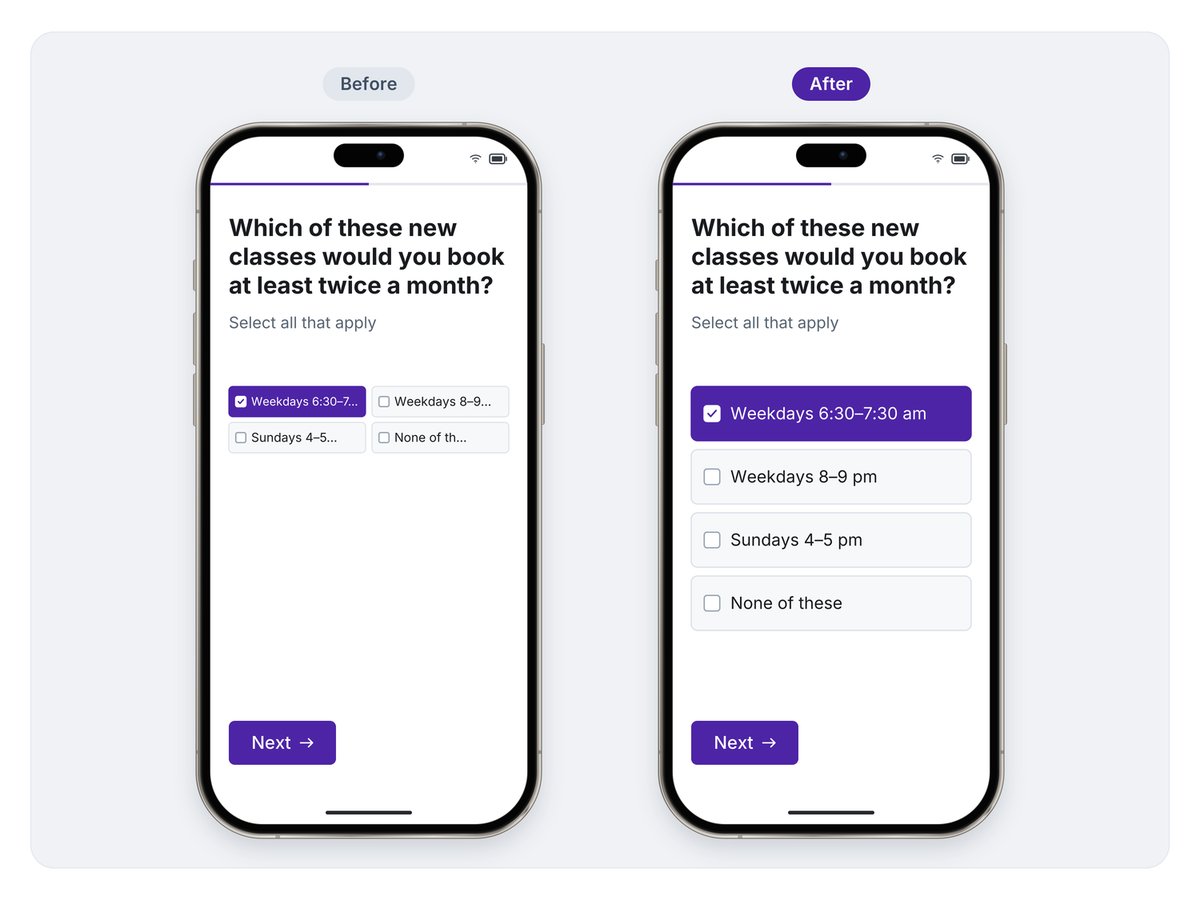
One question, two layouts: squeezed columns and a single column of checkboxes
Pollsar handles part of this on its own: a matrix question turns into a list on phones, and a Group with One Page puts related questions on one screen. Routing in a group works for the group as a whole, so keep a question with its own route, like the club's question 6, outside the group.
8. Pilot on 5–10 people before launch
A think-aloud pretest shows how people read your questions, which is exactly what the author cannot see. Pew Research Center often tests new questions through focus groups, cognitive interviews and pretests before using them in a production survey. For a small project, 5–10 people from the groups you will survey is a practical start.
- Pick the people. The club takes three current members, two former members and one parent from the waiting list. The people who wrote the survey do not count.
- Use the real thing. Send the actual link to the device they would use, usually a phone.
- Ask them to think aloud. Read each question out loud and tell me what goes through your head as you answer. Then stay quiet: if you explain a question, you hide the problem.
- Watch for five signals. A pause or a reread; it depends; a question about what a word means; an Other with an answer that belonged on the list; a skipped or randomly clicked question.
- Ask them to retell two questions. What was question 4 asking you, in your own words? If the retelling differs from what you meant, the wording is the problem, not the person.
- Fix and test again. Change the wording, then show the changed questions to two or three new people.
The club's pilot surfaced a wording problem: one former member read early morning as 5:30 am and answered no, which is why the final list names exact times. The team's own test run found a logic problem: a former member who picked None of these was still asked the rejoin question, because the rule pointed to the wrong answer.
So run every route yourself before people do: a current member, a former member who chose a time, a former member who chose none and someone on the waiting list. In Pollsar the test run in the preview applies all rules and logic and is not recorded in the statistics, and the AI assistant can flag branches no one can reach. The steps are in the help article on testing a survey before launch.
9. Time silent runs and promise the honest number
People decide whether to start by the time you promise and quit when the promise breaks. Do not guess it from the number of questions, and do not take it from the think-aloud pilot, where people read aloud and talk. Once the wording is final, ask a few people who have not seen the survey to take it silently on their phones, covering each route, and time them from the first screen to the thank-you page.
Say six such runs take 2, 3, 3, 3, 4 and 6 minutes. The middle value is 3 and five of six finished within 4, so the welcome page says about 4 minutes. If the honest number is longer than the survey deserves, cut questions, not the estimate. The time is one of the five lines a good survey introduction needs.
Launch, then turn the answers into a timetable
Send a first wave that includes people from every group and look at the answers from each route before inviting the rest: a question many people skip, an Other that keeps getting the same answer, a block where everyone picks the same column. If you change a question, keep the answers to each version apart.
Then apply the rule from step 1, counting each person once for every time they chose. Say 260 people answer, and question 4 gives 71 for weekdays at 8 pm, 52 for weekdays at 6:30 am and 38 for Sundays at 4 pm. Two times clear the bar of 40, so the club trials 8 pm and 6:30 am and leaves Sunday for later. Say 19 of the 30 former members who chose a time answer Likely or Very likely in question 6; the club treats that as a hope, not a forecast, until bookings come in. After six weeks of real bookings, the committee decides which trial stays. The general method for reading results is in the guide to survey analysis.
Not every survey needs a blank page, and a common question usually has a ready draft you can adapt instead of writing from scratch. If yours is why people stop coming, start from the ready survey on barriers to attending events, run it through the same steps, and find more drafts in the survey templates gallery.
More questions about how to design a survey
What are the four types of surveys?
No single list of four or five types is standard; it depends on what you group by. By how answers are collected: online, phone, in person and paper, plus mixed-mode surveys that combine them. By timing: a one-time snapshot, repeated snapshots of the same population, or a panel that follows the same people over time. The club survey is a one-time online snapshot; asking the same members again after the trial would turn it into a small panel.
What are the 4 components of a survey?
There is no fixed standard, but a common split is the introduction, the instructions, the questions with their answer options and the closing. The club's questionnaire above has all four: the welcome page, the instruction each question carries, eight questions and the final page.
From a decision to a link you can send
Write the decision and the action rule in two sentences, list the unknowns and who holds them, and give that to Pollsar's AI assistant in the Create with AI tab. It drafts the questions with answer options and routing; you review the draft, run the pilot and test every route. It is free to start, no credit card needed.