Poll vs Survey: Which One Does Your Question Need?
For a quick group decision, a poll asks for one choice and gives you a tally. A survey asks several questions, so you can connect that choice to a reason or compare how different groups answered. That is the practical difference between a poll and a survey. If the tally alone tells you what to do next, a poll is enough. If a likely result would leave you asking why? or which of them?, you need a survey, and three or four questions are often enough.
Poll vs survey: what is the difference?
- Questions. A quick group poll usually asks one question with a few choices. A survey asks several, often of different types, about reasons or about who is answering.
- What you get. Poll: a tally and percentages. Survey: the tally plus whatever the extra questions ask for, such as reasons or differences between groups.
- Effort for the person answering. Poll: one choice to make. Survey: each extra question asks more, especially when people have to write.
- Reading the results. Poll: one chart. Survey: answers read together, such as the reason given by everyone who said no.
- Best for. Poll: a quick choice you can act on. Survey: a decision you would get wrong if you misread the people behind the numbers.
Is a poll a survey?
In everyday use, a poll is the smallest kind of survey: one question, quick answers, a tally. Professional pollsters use the word more broadly, and a national opinion poll is a survey of a carefully chosen sample that can ask many questions. On a team, in a classroom or in a members' group, poll means the one-question version, and that is the sense this guide uses. A show of hands before a meeting decides anything is a poll too, and the guide to the straw poll covers that case.
Can you act on the tally? Run the next-step test
The choice gets easy once you stop thinking about the question and start thinking about what you will do with the answer. Take two minutes before you send anything.
- Write the question and its likely answers. Three or four, the way you would offer them. If two of them overlap, the guide to multiple-choice questions shows how to separate them.
- Write what you will do with each likely result. Pizza wins: order pizza. Tuesday wins: move the session. Then add two more lines. If the top two tie, who breaks the tie? If too few people vote, whom will you ask next?
- Look for a line you could not fill. If one reads depends why or depends who, a poll will not settle it.
Those two blanks are the whole rule. Depends why means you need a reason, so you need at least one follow-up question. Depends who means the answer may differ between groups, such as regulars and newcomers or two departments, so you need a question that sorts people. If every line has an action next to it, the tie and the low turnout included, a poll is enough, and anything longer only costs your audience time.
- Team lunch: Pizza or tacos on Friday? Every answer ends with an order. A poll.
- Teacher: Which date works for the review session? The winning date is the decision. A poll.
- Creator: Should the newsletter stay weekly? If 40% say no, you still don't know whether the problem is length, timing or topics. Depends why: a survey.
- Nonprofit: Could you volunteer on weekday evenings? Students and working volunteers may answer very differently, and you staff shifts by group. Depends who: a survey.
The gray zone: a single follow-up
Many questions need just one why. Ask the poll question, then show one follow-up only to the people who picked the answer you can't act on. Call it a poll with a follow-up or a short survey; for a single decision it is often the right size. This is also the point where a poll inside a chat stops. If everyone you need is in one chat, its own poll handles the one-question version: WhatsApp and Microsoft Teams have one built in, and Slack does it with emoji reactions or an app such as Simple Poll or Polly, as the guide to polls in Slack shows. A follow-up shown only to some voters usually needs a link to a survey. Once you add a question that sorts people into groups, or a second reason question, plan it as a full survey, in the order the decision needs, as described in the guide on how to design a survey.
One question asked both ways: the early class
Say Maya runs a small yoga studio with 120 members. An instructor has offered to teach an early weekday class, and Maya will keep it only if at least 12 members come regularly. She runs the next-step test. Enough yes votes: she tries the class. Too few: she drops it. Many no votes leave a blank, because a no to 6:30 might mean not in the morning or only not at that hour. By her own test she should write the follow-up now. She is in a hurry, so she sends the one-question poll anyway and watches that line.
Step 1: the count
Maya posts one question as a link in the members' group chat: Would you come to a 6:30 a.m. weekday class? The answers are Yes, at least once a week, Maybe and No. In two days, 52 members vote.
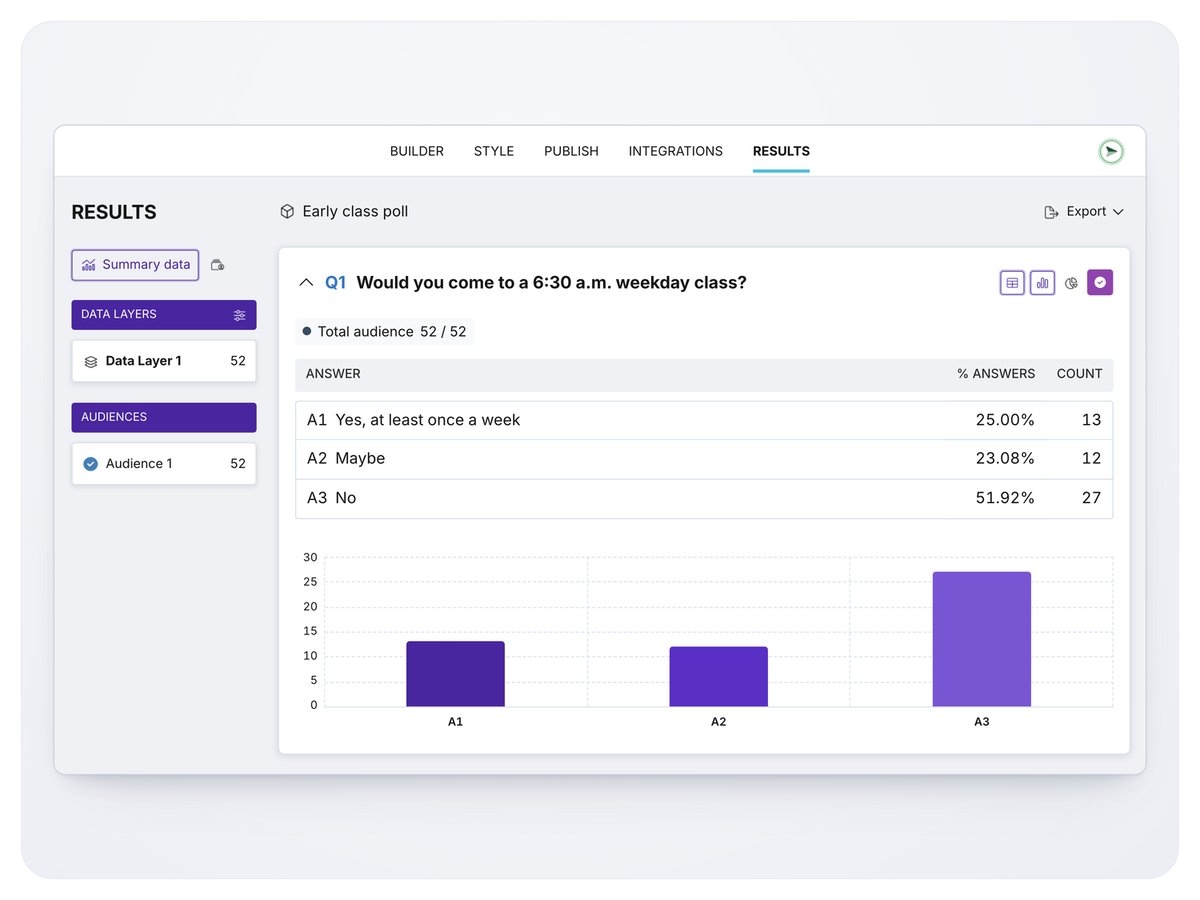
The poll after two days: 52 votes
Thirteen members say they could come weekly. That clears her bar of 12, but only just, and saying you will come is not the same as coming. Twenty-seven say no. If mornings are impossible for those 27, a different start time won't bring them in, and Maya doesn't yet know what would work for the 12 who said Maybe. If 6:30 itself is the obstacle, a later class might draw more people. The tally cannot tell her which, and that is the depends why line from her test.
Step 2: the reasons
Maya keeps the poll question word for word as question 1, so she can set the two results side by side, and adds three more.
- Would you come to a 6:30 a.m. weekday class?
Yes, at least once a week / Maybe / No - What is the main reason?
6:30 is too early for me / Mornings don't work for me / I'd want a different type of class / Other - Which weekday start time would you be most likely to attend each week?
6:30 / 7:00 / 7:30 / I wouldn't come in the morning - What, if anything, would make a morning class easier to fit into your day?
A text box
Question 2 is only for people who answered Maybe or No; asking a yes voter for their reason to say no just confuses them. In Pollsar this is a Rule on question 1 that sends Yes straight to question 3, as shown in survey logic basics. Maya emails the link to all 120 members, and 40 answer within a week.
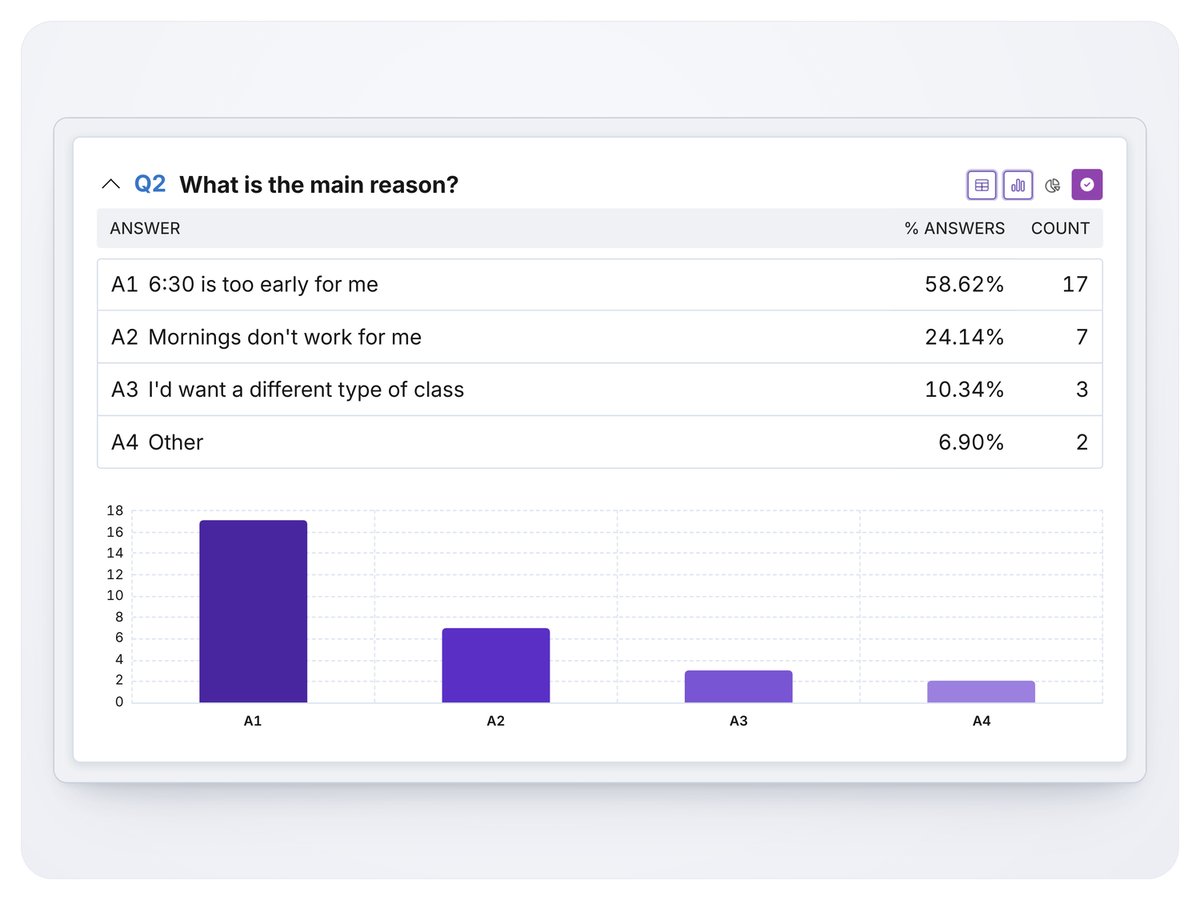
Question 2 of the survey: 29 members who answered Maybe or No
- The shares look alike. This time 11 of 40 said yes, or 27.5%, against 13 of 52, or 25%, in the chat. Maya sent the two rounds through different channels and doesn't know how many members answered both, so the match is a hint, not a check.
- The hour is the main obstacle. Of the 29 members who answered Maybe or No, 17 said 6:30 was too early. Seven ruled out mornings altogether.
- 7:00 comes first. It was the most popular start time, with 16 of 40 answers; 6:30 got 9, 7:30 got 8, and 7 people wouldn't come in the morning.
- The text box sets the length. Several members wrote that they need to leave by 8 to get to work. A 45-minute class at 7:00 ends at 7:45; an hour-long one would end right at 8.
So Maya schedules a 45-minute class at 7:00 for four weeks and counts who actually comes. Sixteen people picking a time is a preference, not a booking, and attendance decides whether the class stays. With the poll alone she would have tested 6:30, the hour most of her hesitant members had just turned down. Looking back, the blank line in her test had already asked for the follow-up. One poll with a single follow-up for Maybe and No would have shown the hour problem in the first round, without asking 120 people twice. If you want more wordings for a last question like number 4, the guide to open-ended questions has 50 of them.
When to go straight to a survey
Sometimes you can tell in advance that a single question won't settle anything. Which kind of survey you then need depends on its purpose, timing and channel, laid out in the guide to types of surveys.
- You can't write the answer options yet. If you don't know the likely answers, a list of options will miss the real one. Start with an open question.
- You already expect a split. If the topic has divided people before, a poll will only confirm the split. Ask for the reasons in the same round.
- You need to compare groups. Teams, classes, regulars and newcomers: add a question that sorts people, and you have a survey; comparing the groups afterward is a step in the guide to survey analysis. Tracking one choice over time does not need this; repeat the poll with the same wording and reach people the same way.
Frequently asked questions
What is the purpose of a poll?
A poll gives a group a quick count on one question, so it can make a choice or see where it stands without a meeting. It shows how many chose each answer, not why they chose it.
What is the difference between a poll and a questionnaire?
A questionnaire is the set of questions people answer. It can hold a single poll question or the longer series a survey uses.
How many responses does a poll need?
No number fits every group. Before you ask, agree on the turnout you need to act, then check whether everyone affected had a chance to answer. Maya's 52 votes out of 120 showed a split, but they could not speak for members who never open the group chat. If some people are outside the chat, send the question through a channel they use.
Before you send your question
Write the likely results and the action next to each, then look for the blank line. If there isn't one, the tally will settle it, so send one question as a link or a QR code with the free poll maker. If you find a depends why or a depends who, write the follow-up before you invite anyone, then describe the decision to the AI assistant in Pollsar's survey maker and check the draft it builds.