Bloom's Taxonomy: The Six Levels, Their Verbs and a Quiz That Uses Them
Bloom's taxonomy sorts thinking tasks into six levels, from remembering a fact to creating something new. Teachers use it for two jobs: writing lesson objectives with the right verb, and checking that a test asks for the kind of thinking the lesson taught. Below are the levels with verbs you can copy. Then comes a step most guides skip: one topic turned into a six-question quiz, one question per level, and a way to read the result for your class.

What is Bloom's taxonomy, and who created it?
A taxonomy is a classification, and Bloom's taxonomy is defined narrowly: it means a classification of cognition, the thinking a task demands, not of its topic. Starting in 1948, a group of American college examiners led by Benjamin Bloom, an educational psychologist at the University of Chicago, wanted a shared vocabulary for educational goals so that examiners at different universities could describe and swap test items, as David Krathwohl recalled in his 2002 overview of the revision. The group's 1956 book, Taxonomy of Educational Objectives, Handbook I: Cognitive Domain, was written by Bloom, Max Engelhart, Edward Furst, Walker Hill and Krathwohl.
Take two questions about one topic: Name the four stages of the water cycle and Explain why a puddle dries up. The topic is the same, the thinking is not. Bloom's taxonomy explained in one sentence: it gives teachers a plain way to say what a question really asks of a student. That is why the framework has outlived most fashions in education.
The original and the revised Bloom's taxonomy
Two versions are in use, and sources mix them. The original, the old Bloom's taxonomy of 1956, has six categories named with nouns. The 2001 revision by Anderson, Krathwohl and colleagues, published as A Taxonomy for Learning, Teaching, and Assessing, renamed them with verbs, because learning is something students do, and changed the top. This is the new, updated or modified version, and it is the one most schools mean today. Some sources use -ing names such as applying, evaluating and creating; they are the same levels.
- Knowledge became Remember.
- Comprehension became Understand.
- Application became Apply.
- Analysis became Analyze, spelled analyse in British English.
- Evaluation became Evaluate and moved from the top to fifth place.
- Synthesis became Create and took the top place.
The revision also added a second dimension that rarely reaches posters: the kind of knowledge, whether factual, conceptual, procedural or metacognitive. This guide stays with the six cognitive levels. A later add-on, Bloom's digital taxonomy adapted by the teacher Andrew Churches, lists the same levels with digital verbs such as bookmarking and blogging.
Posters, diagrams and other graphics draw the levels as a pyramid or triangle with Remember at the base. Some use a grid or a flip chart, and they all say the same thing: the order runs from simple to complex. The hierarchy is less strict than the picture suggests, as the section on whether the taxonomy is still relevant explains.
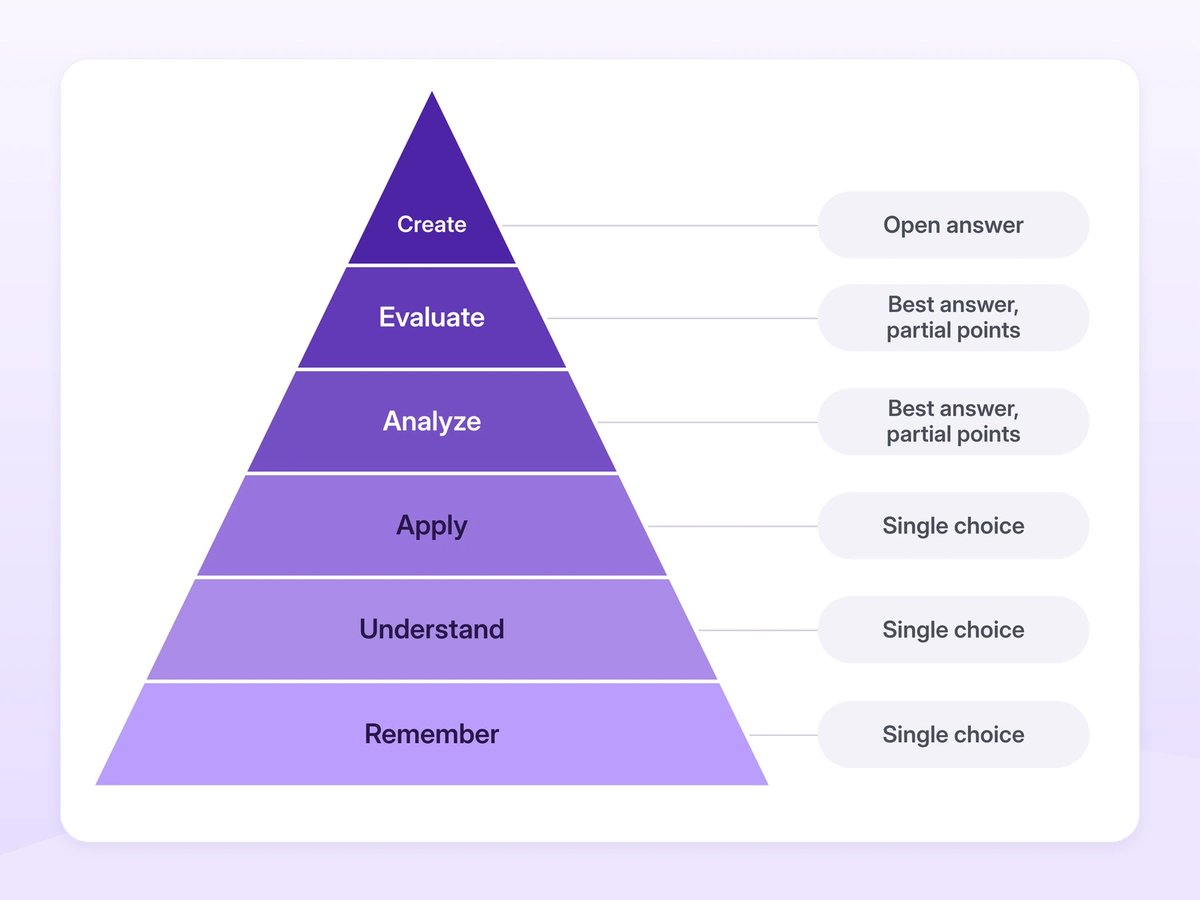
The six levels of the revised Bloom's taxonomy, and the question format used at each level in the water-cycle example
The six levels of Bloom's taxonomy, with verbs
Each level below gives what the student does, verbs for objectives and questions, and how a quiz can check it. Verb wheels and posters list dozens of words, so the shorter lists here are easier to keep in your head. A verb belongs to a level only in context: describe is remembering when students recite a definition and analyzing when they describe how two graphs differ. Read the verb together with the task.
1. Remember
- Student does: retrieves a fact, term or step from memory.
- Verbs: define, list, name, label, recall, state, match, identify.
- In a quiz: single choice. The answer is right or wrong, so points can be counted automatically.
2. Understand
- Student does: explains an idea in their own words and shows they grasp the meaning.
- Verbs: explain, summarize, paraphrase, classify, interpret, describe, give an example.
- In a quiz: single choice where the options are explanations and the wrong ones are built from common misconceptions. Points are automatic.
3. Apply
- Student does: uses a rule or method in a situation that is new to them.
- Verbs: use, solve, calculate, demonstrate, carry out, show, complete.
- In a quiz: single choice set in a situation the lesson did not cover. If the situation was in the lesson, the question tests memory.
4. Analyze
- Student does: breaks material into parts and sees how they relate: cause and effect, claim and evidence, what is alike and what differs.
- Verbs: compare, contrast, distinguish, examine, break down, categorize, infer.
- In a quiz: a best-answer question. Several options are reasonable and one fits best, so the best one earns more points than a good but weaker one.
5. Evaluate
- Student does: judges a claim, method or solution against criteria and gives a reason.
- Verbs: judge, justify, critique, defend, assess, recommend, prioritize.
- In a quiz: a best-answer question with partial points, or an open why that you read yourself.
6. Create
- Student does: puts parts together into something new: a plan, a design, a text, a model.
- Verbs: design, plan, compose, construct, propose, develop, formulate, invent.
- In a quiz: an open text answer. You read it, because no option list can hold what students invent.
Bloom's taxonomy action verbs for learning objectives
A learning objective says what a student will be able to do, and the verb carries the meaning. Know and understand look like verbs but fail the test, because you cannot observe understanding. Measurable verbs, the keywords of an objective, name something you can see or hear, so the same verb tells you what to ask in the check. An objective has three parts: the verb from the level you want, the content, and the condition or standard.
- Before: Students will understand the water cycle. After: Students will explain why a puddle dries up, using the words evaporation and water vapor. The first version gives no hint of what to teach or ask. The second one does.
- Before: Students will know the stages of the cycle. After: Students will name the four stages and put them in order. The verb name is observable, and the order gives a standard.
- Before: Students will think critically about experiments. After: Students will judge whether a classmate's conclusion is supported by the measurements and give one reason. Now the level is Evaluate, and the answer has a shape.
The short lists above are enough for most objectives. When you need more choice, these verbs fit the same levels.
- Remember: recognize, repeat, memorize, locate, select, recite.
- Understand: discuss, restate, translate, illustrate, predict, outline.
- Apply: implement, practice, compute, operate, model, apply.
- Analyze: organize, differentiate, attribute, sort, question, test.
- Evaluate: argue, check, rate, rank, appraise, support.
- Create: build, produce, write, generate, devise, assemble.
In lesson planning, put the verb of the objective, the activity and the check on one line, so all three ask for the same thinking. Most lessons need two or three levels, not all six. A lesson taught at Apply and tested at Remember tells you nothing about whether the learning outcomes were met, and students can discuss the difference themselves if you show them the verbs. A quiz like the one below is one form of formative assessment, a check made while you can still change the teaching.
Bloom's taxonomy in a lesson plan: one line per level
A lesson plan using Bloom's taxonomy needs one line for each level you teach: objective, activity, check. For the water cycle, three lines are enough.
- Understand. Objective: explain why a puddle dries up. Activity: pairs explain to each other why wet hair dries. Check: question 2 of the quiz below.
- Apply. Objective: use condensation to explain a case not seen in class. Activity: students explain a bathroom mirror that fogs after a shower. Check: question 3, the glass of ice water.
- Evaluate. Objective: judge whether a conclusion fits the measurements. Activity: the class judges the sentence Wet clothes dry only in the sun. Check: question 5.
The three domains: cognitive, affective and psychomotor
The six levels are the cognitive domain, which is thinking. Bloom's group planned two more domains. The affective domain, by Krathwohl, Bloom and Masia in 1964, covers attitudes and values, from receiving and responding to valuing, organizing and finally living by a value. The psychomotor domain, physical skill, was not written by Bloom's team: Dave, Simpson and Harrow proposed versions in the early 1970s.
A school quiz measures the cognitive domain. For the other two, watch and ask. You see psychomotor progress when a student focuses a microscope without help. You can ask about the affective side with one question, such as How confident do you feel explaining evaporation to a friend?, on a five-point rating scale.
Higher-order thinking: the highest and lowest level
Remember is the lowest level and Create ranks highest in the revised taxonomy. In the 1956 original the top was evaluation. Educators call analyze, evaluate and create the higher-order thinking skills, the ones behind critical thinking. Lower does not mean worse. Nobody analyzes a chart without knowing what its labels mean, so a missed vocabulary question is a reason to check whether unfamiliar terms are getting in the way. The point is balance: if every question you write sits at Remember, the grade only tells you who studied the words.
Turn the levels into a quiz: one topic, six questions
A list of verbs does not tell you where your own class is stuck. A quiz built on the levels does. Take a topic you have just taught and write one question per level. Here is the topic the water cycle for grade 5, with the answer format each level calls for. The wrong options come from real misconceptions, and writing them well is a craft of its own, covered in the guide to multiple-choice questions.
1. Remember. What is it called when water vapor turns into tiny drops of liquid water?
- Evaporation
- Condensation, 1 point
- Precipitation
- Collection
2. Understand. Why does a puddle on a paved playground disappear on a warm, sunny day?
- The pavement soaks up all of the water.
- The water turns into water vapor and mixes into the air, 1 point
- The sun breaks the water into pieces too small to see, and they stay on the ground.
- The wind carries the liquid water away in one piece.
3. Apply. A glass of ice water stands on a table in a warm room. Drops of water appear on the outside of the glass. Where did they come from?
- The water seeps through tiny holes in the glass.
- Water vapor in the room air cooled on the cold glass, 1 point
- Ice melted inside the glass and ran down the outside.
- The cold makes new water out of the glass.
4. Analyze. Two identical puddles lie on the same playground. After one hour the puddle in full sun is gone and the puddle in the shade is half full. Which sentence correctly separates what stayed the same, what changed and what was observed?
- Same: the puddles and the playground. Changed: how much sun each puddle got. Observed: the sunny puddle dried first, 2 points
- Same: the puddles and the playground. Changed: how much sun each puddle got. Observed: the sun made the water evaporate, 1 point. It names the changed condition but states an explanation as if it were seen.
- Same: how much sun each puddle got. Changed: the size of the puddles. Observed: the shaded puddle was half full.
- Same: the amount of water left. Changed: the playground. Observed: the sunny puddle was bigger.
5. Evaluate. Mia left one bowl of water in a sunny window and an identical bowl in a dark closet. After a day the window bowl had lost 40 milliliters and the closet bowl 5. Mia writes: Water needs sunlight to evaporate. Which comment on her conclusion is best?
- The measurements fit a link between sunlight and evaporation, but the closet bowl lost water too, so needs goes too far, 2 points
- She should repeat the test with more bowls, 1 point. Good practice, but it misses the flaw in the words.
- Her conclusion is right, because the sunny bowl lost more water.
- The test is useless, because the closet bowl lost water.
6. Create. Plan a test to find out whether wind makes a puddle dry faster. Write what you will change, what you will keep the same and what you will measure.
Set the points and the final pages
In Pollsar a quiz is a survey in which each answer option adds points to a variable, here score. Questions 4 and 5 use partial points, the open question carries none because you read it, the most a student can score is 7, and each score range opens its own final page.
- 0 to 3 points: You scored {score} out of 7. We will go back over the main ideas together.
- 4 to 5 points: You scored {score} out of 7. Next, explain where the drops on a cold glass come from.
- 6 to 7 points: You scored {score} out of 7. Now try the open question again with a new test.
Students open the link or scan the QR code on their phones and answer without names or emails, so you see the class picture, not who answered what. Describe the quiz in the Create with AI tab and the AI assistant builds the questions with their points; the quiz maker page shows the rest of what a quiz in Pollsar can do.
Read the class profile: where the thinking breaks
Say 24 students take the quiz. In Results, Pollsar shows every question with its answers, counts and percentages, as a table, bars or a pie. Open each question as answers come in and record the number who chose the best answer, one per level, and you have the profile of the class. Here is the share of students who chose the best answer at each level:
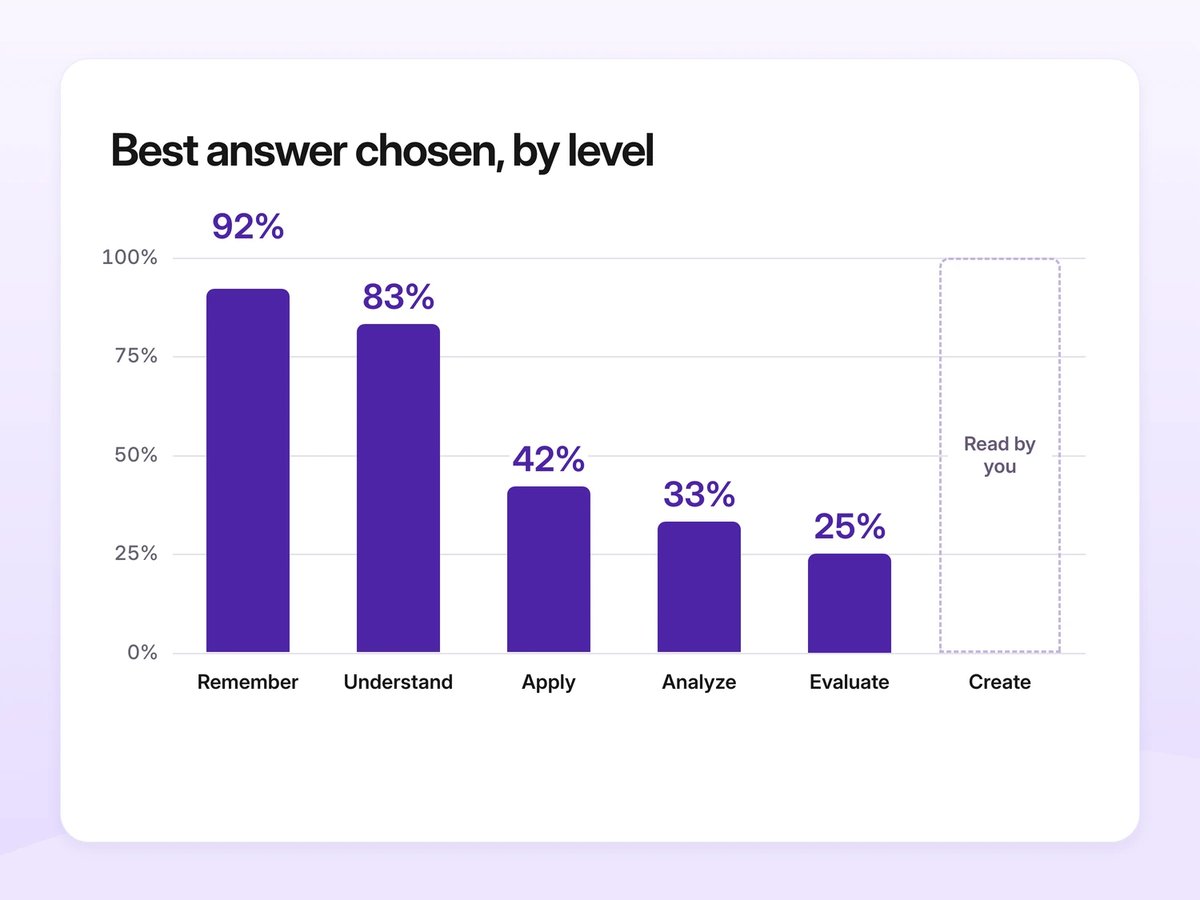
The class profile: strong on Remember and Understand, a steep drop at Apply
The shape is the message, and it is a hint, not a verdict: one question cannot pin down a student's level. Ten of 24 chose condensation in the new setting, compared with 22 on the plain recall question. Try a second condensation example to see whether the difficulty carries over. Then look at the Apply question itself: 11 of 24 chose the water seeps through tiny holes in the glass. That wrong answer is a specific idea the students hold, and it is worth more to you than the score.
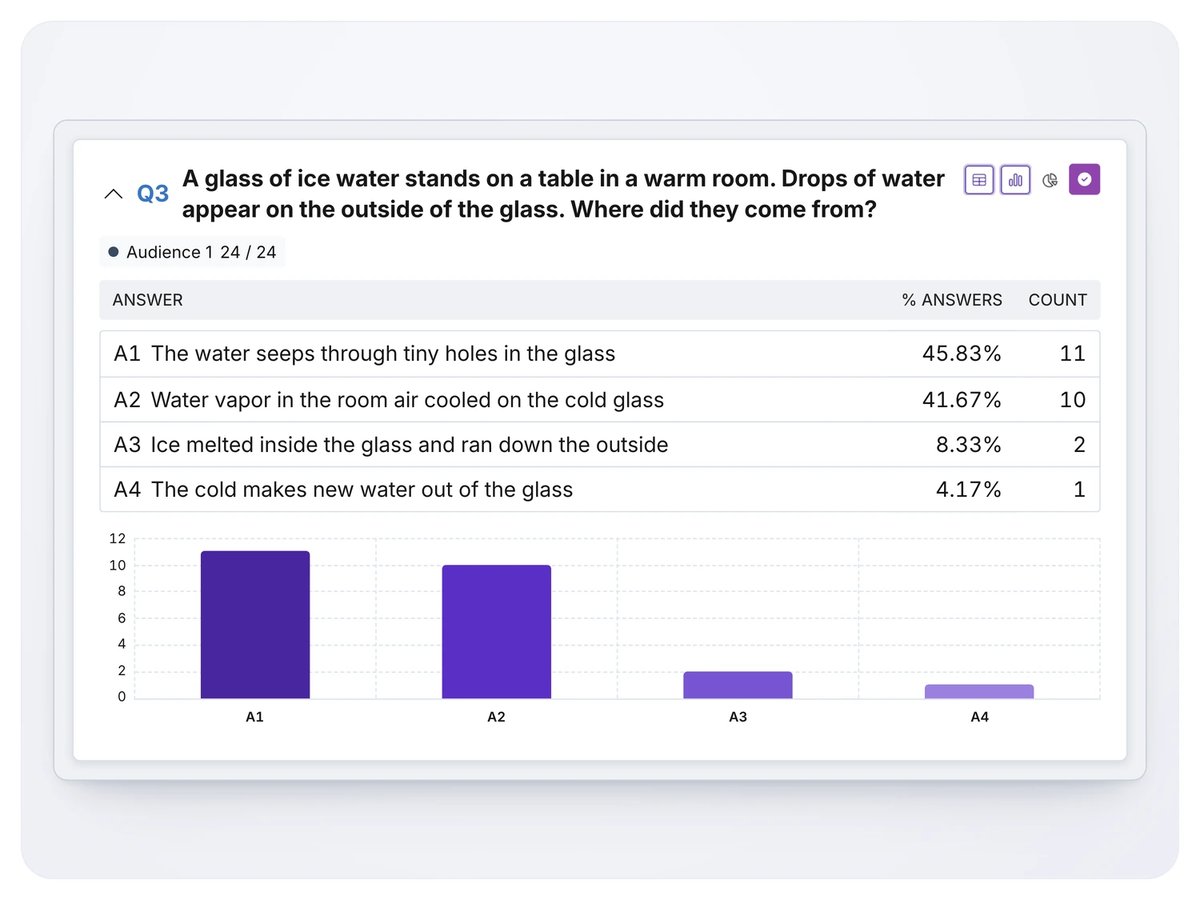
Results for question 3: the most chosen wrong answer is the misconception to work on
What to do depends on where the profile drops:
- Remember is high, Understand is low. Students memorized terms without the explanation. Ask them to explain in their own words before you move on.
- Remember and Understand are high, Apply is low. They know the idea and do not carry it to a new case, as above. Work one new situation together, then give them another to do alone. For the glass, put a glass of ice water on the desk and let them watch.
- Apply is fine, Analyze is low. They use a rule when told which one, but do not yet separate causes. Give two cases side by side and ask what differs.
- Analyze is fine, Evaluate is low. They lack criteria for judging. Give a short checklist before asking for a verdict.
- Everything is low from the start. The topic needs to be retaught, and the levels are not the issue.
The open question you read yourself. Sort the answers into three piles: plans that change one thing at a time, plans that change several, and plans with nothing to measure. For a longer task, a rubric gives the piles names. After the reteach, ask a fresh Apply question on a new situation and compare the bar. A class that moves it is learning. A class that does not needs a different explanation, not more of the same.
Bloom's taxonomy examples in math
The same six levels work in any subject. In mathematics, take the area of a rectangle:
- Remember. Which formula gives the area of a rectangle?
- Understand. Why is area measured in square units?
- Apply. A room is 4 m by 6 m. How much carpet covers its floor?
- Analyze. Two rectangles both have a perimeter of 20 m, one 5 m by 5 m and the other 1 m by 9 m. Which has more area, and what happens to the area as the shape gets longer and thinner?
- Evaluate. A student says a 3 m by 8 m room needs 22 square meters of carpet, because 3 + 8 + 3 + 8 = 22. Judge the answer.
- Create. Write a word problem whose answer is 24 square meters.
Is Bloom's taxonomy still relevant?
Yes, as a vocabulary, with caveats that honest guides add. The levels are not a strict staircase: a student can analyze a graph before they can recite its terms, and many tasks sit between two levels. Verbs are hints, not proof, since one verb fits several levels. And the 1956 version came from exam writers, not from classroom research on how children learn. Treat the taxonomy as a check against questions that are all alike, not as a theory of learning. If you want a different lens, three alternatives to Bloom's taxonomy are widely taught:
- SOLO taxonomy by John Biggs and Kevin Collis, which describes how much structure a student's answer shows, from isolated facts to a connected, extended idea.
- Webb's depth of knowledge by Norman Webb, which rates how complex a task is.
- Fink's taxonomy of significant learning, which adds the human dimension, caring and learning how to learn, to the cognitive levels.
Bloom's taxonomy: quick answers
Why is Bloom's taxonomy important?
The purpose of the taxonomy is a shared language for goals, tasks and tests, and its importance in education is practical: it keeps questions honest. Without a framework, tests drift toward recall, because recall questions are the fastest to write and to grade. The levels give you a quick check that lesson goals, activities and quiz all ask for the same thinking, and a clear reason to give students when one task is harder than another.
Is there a printable Bloom's taxonomy sheet or a revised Bloom's taxonomy PDF?
Copy these six lines into your lesson plan or print them for your desk.
- Remember: name, list. What is the term for this?
- Understand: explain, summarize. Why does this happen?
- Apply: use, solve. What happens in a case we have not seen?
- Analyze: compare, distinguish. What differs between these two, and why?
- Evaluate: judge, justify. Which conclusion is best supported, and why?
- Create: design, plan. Plan a test that would show this.
The sources are the 1956 handbook and the 2001 book by Anderson and Krathwohl. Krathwohl's 2002 overview in Theory Into Practice is a short, clear read.
Make the quiz for your class
Take a topic from this week, replace the water cycle in the description above and let the AI assistant build the six-question quiz with its link and QR code. After you reteach, try a fresh Apply question and compare the explanations students give. Start free, no credit card.