Test Taking Strategies That Work, With a Practice Quiz
A student who knows the material can still lose five points to a question that says NOT, to two near-identical options, or to a clock nobody watched. Test taking strategies, also called test-taking skills, tips or techniques, are the habits that stop those losses: how to read a test, spend time on it, choose between options and check the result. They can be taught in a few short sessions, like any other skill. Below are ten that fit any test, the moves for each question type and subject, and a practice quiz in which every question trains one strategy.

10 test taking strategies for any test
These ten are good test taking strategies for any subject. Print the list as a handout, a poster or an anchor chart. Each strategy comes with its reason, because students keep a rule longer when they know what it protects.
- Look over the whole test first. Where the format lets you see it, count the questions and sections and split the time before you start, so a long essay does not surprise you with five minutes left.
- Read the directions twice. Choose one, choose two, mark all that apply and choose the best answer ask for different things.
- Start with what you know. Easy points go in the bank first and warm up your memory for the rest. If the test lets you return, flag the hard question and come back before the current section closes. If each answer locks when you move on, make your best choice now.
- Spend time by points. A one-point question does not deserve the minutes of a ten-point one.
- Do a brain dump. If the test allows it, write formulas, dates or a memory trick in the margin in the first minute, before nerves take them.
- Read every option before you choose. The first option that looks right is often the one built to look right.
- Cross out before you choose. This is the process of elimination: removing even one wrong option raises your odds and often shows you the answer.
- Circle the small words. NOT, EXCEPT, ALWAYS, NEVER, ONLY and BEST change the whole question.
- Answer the question that was asked. A true fact that answers a different question earns nothing.
- Use the last minutes on blanks and flagged answers. Make sure every question has an answer, then reread the ones you marked.
Before and after the test count too
What students do in the week before decides how much a strategy has to work with. Six habits carry most of it.
- Practice under test conditions. Same format, same time limit, no notes, so the real test feels familiar.
- Test yourself instead of rereading. Writing your own questions, with wrong options included, shows what you cannot yet recall.
- Spread review over several days. Spacing is among the best-documented effects in learning research, and the evidence base is large: Cepeda and colleagues reviewed more than 300 experiments on it in a 2006 paper in Psychological Bulletin.
- Sleep and eat before the test. Tired students misread questions they could answer.
- Pack the night before. Pencils, an approved calculator, a watch if one is allowed and water, so the morning holds no surprises.
- Arrive early. Ten spare minutes cost nothing. A late start costs the first questions.
After the test, ask students to sort every lost point into one of four causes: did not know it, misread it, ran out of time, changed a right answer to a wrong one. That sort turns a grade into a plan, and it is the same habit of watching your own thinking that metacognition builds. The sort belongs to the student, so it works without a teacher in the room.
Best test taking strategies for multiple choice
Multiple choice is the format where strategies pay off most, because wrong options are written to catch half-finished thinking. Take this one.
First estimate: 25% off is about a quarter less than $40, so the answer should be near $30. Then cross out. $40 is the price with no discount, and $20 takes off far too much. The $10 option is the trap: it is the size of the discount, the number a student reaches halfway through the work. $30 stays. A student who computes first and looks at the options second tends to see $10, recognize it, and stop.
Wrong options are usually made of the mistakes students really make, so crossing out is a way of thinking, not a trick. These five patterns come up on tests of every subject.
- Negatives. In Which of these is NOT a mammal? Dolphin · Bat · Shark · Whale, find the three true ones first. The one left is the answer, shark.
- Absolute words. All, none, always, never, only and every are easy to break with one exception, so check whether you can think of one. In Every prime number is odd, the number 2 breaks it.
- All of the above. If you can confirm two options as correct, all of the above is often the answer, but read the remaining options before you choose.
- Two options one word apart. The difference is what the question tests. Read those two the most closely.
- Echo words in reading questions. Wrong options often repeat words from the passage. Match the meaning of the sentence, not its words.
Is it better to guess B or C?
Neither. Test writers shuffle the options, and a pattern on one test says nothing about the next, so a favorite letter is a habit, not a strategy. Whether to guess at all depends on the scoring rule. On the ACT, incorrect answers carry no penalty, as act.org states. On the digital SAT, College Board advises most students to guess rather than leave a blank, especially after eliminating one or two options. For another test, read its scoring directions before choosing a guessing strategy: if it says wrong answers lose points, the penalty is usually set so that blind guessing gains nothing on average, and a guess pays only after at least one option is crossed out.
Test taking strategies by question type
- True or false. One false word makes a statement false. Look for it, and treat absolute words as a warning.
- Matching. Match the sure pairs first and strike them through, so the doubtful ones have fewer partners left.
- Fill in the blank. Say the sentence aloud with your answer in it. Check that the grammar fits and that you gave the unit when a number is asked for.
- Short answer and essay. Spend the first minutes on a three-line outline. Answer the question in the first sentence, then add the evidence.
- Open book. The book saves time only if you know where things are. Tab your notes before the test, not during it.
- Computer-based and timed tests. Learn the interface first: how to flag a question, how to go back, where the clock is. Practice timed on a screen, since a student used to paper loses time on the first screen test, and interactive item types such as drag and drop need a trial run.
Test taking strategies for math, reading and science
- Math and algebra. Estimate before you calculate. Put your answer back into the problem to check it. In algebra with options, substitute each option into the equation, which is often faster than solving it.
- Reading and reading comprehension. Read the questions first, then the passage with them in mind. Reading comprehension and test taking are tied together: a student who cannot find the sentence that supports an answer will lose points however well they read. Put a finger on that sentence before choosing. The same holds on English language arts tests, ELA for short.
- Science. Read the title, the axes and the units of every graph before the question. Underline what is changed and what is measured.
- Social studies. Look at dates and causes. For a claim with always or never, look for a counterexample before you cross it out.
- Writing. Plan for five minutes, write, and leave two minutes to reread for missing words, which a quick reading skips.
Critical thinking questions ask students to analyze or evaluate rather than recall. For them the most useful strategy is to slow down and name what the question wants before looking at any option. The levels of such questions are laid out in Bloom's taxonomy.
Test taking strategies for standardized tests
State tests such as STAAR, SBAC, CAASPP, MCAS, FAST, PSSA, IAR, MCA, Virginia SOL and the end-of-grade and end-of-course exams, EOG and EOC, differ in format, but the strategies above carry over. Use a sample from the test your students will take, and check how sections are timed, whether students can revisit an item and how multi-part answers are scored. Those answers decide when to guess and when to move on, and a student who has met a two-part question or a drag-and-drop item before spends the test on content. For SAT, ACT and nursing licensing practice, the general strategies on this page help, and a practice set for the specific exam does the rest.
Test taking strategies for elementary students
Younger students need fewer steps, said the same way every time. A four-step routine fits on a bulletin board and is easy to chant: Read it, Cross out, Choose, Check. Teach it on one question at a time, aloud, before asking students to use it alone. Third, fourth and fifth graders can use it on multiple choice reading and math. First and second graders practice the same steps orally with two options, and a short rap or song often makes the routine stick. A worksheet with the four steps beside each practice question, printed as a PDF handout, keeps the routine in front of them.
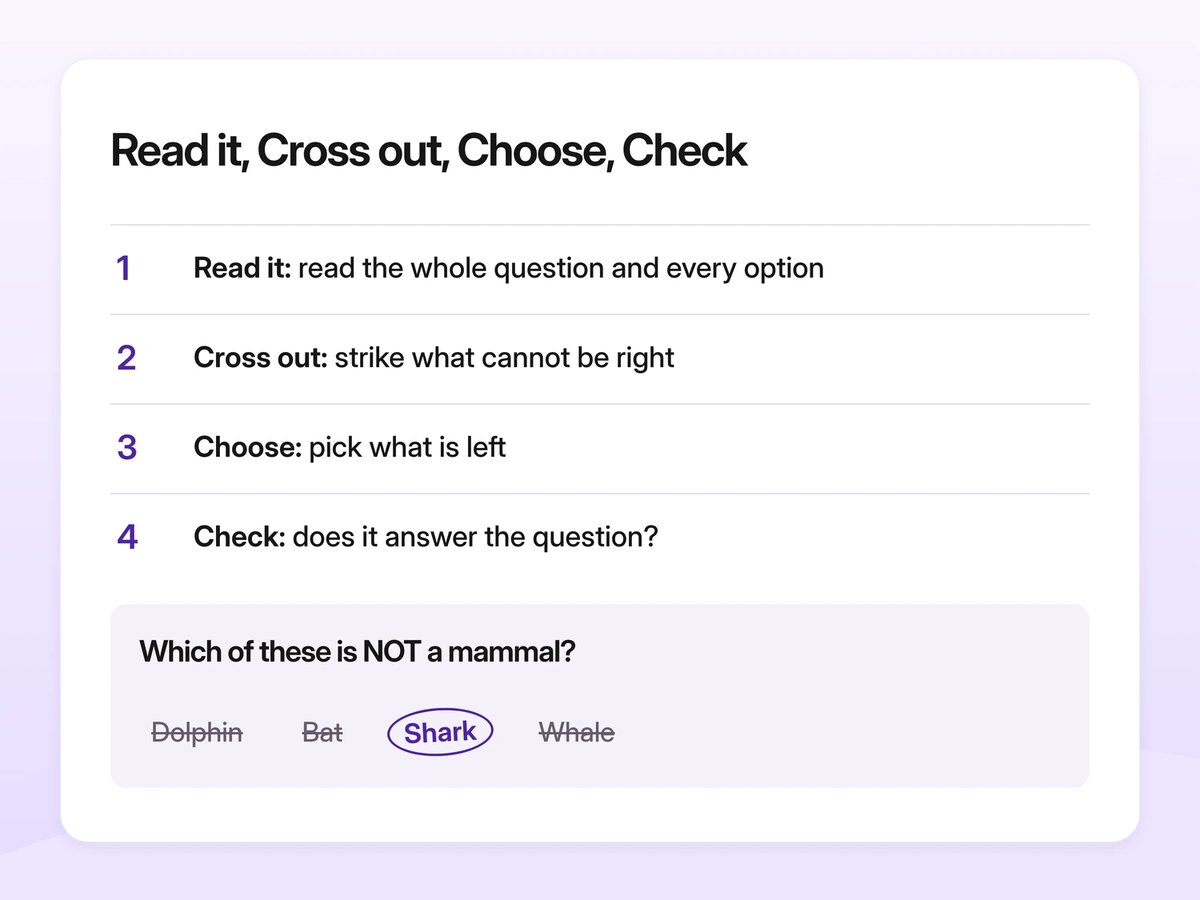
The four-step routine as an anchor chart, worked on one question
Test taking strategies for high schoolers
For high schoolers the same moves work with two additions: budget time by points before starting, and keep a log of lost points sorted by cause, as described above. Older students, including those preparing for college and for medical or nursing programs, use the same habits on longer tests.
Test taking strategies for anxiety
Anxiety takes up working memory, so a worried student has less room for the question. If worry is competing for a student's attention, offer a short writing exercise before a practice test. In a study by Ramirez and Beilock published in Science in 2011, ninth graders who wrote about their worries for ten minutes before a biology exam scored higher, and the gain was largest for highly anxious students. Two more moves help on the day: breathe slowly, four counts in and six out, three times, and start with the easiest question so the first thing on the page is a success. Students should also hear, before any test, that a score measures what they did on one day, not what they are worth.
Test taking strategies for ADHD, learning disabilities and ESL students
Accommodations such as extra time, a quiet room or questions read aloud are set in the student's own plan, so the teacher's job is to confirm that they are ready before test day. Inside the room, these strategies help most:
- Cover the rest of the page with a card, so the student sees one question at a time.
- Check off each question as it is done, which makes progress visible and gaps easy to find.
- Underline the verb and the key nouns in each question before reading the options, which is also the best start for students working in a second language.
- Break a long test into sections with a planned pause between them.
How to teach test taking strategies in class
Teaching test taking strategies works best in short sessions of about fifteen minutes spread over a few days, with two strategies each time. Here is a three-session plan.
- Session 1, pretest. Students take the first set of the practice quiz below cold. You see which traps catch the class, and students see what they miss.
- Session 2, model and practice. Think aloud through two questions. Then pairs write a trap question: one right option and three wrong ones built from real mistakes. Students who must write wrong answers learn to spot them.
- Session 3, second set. Give a second set with new numbers and passages but the same eight strategies, with the same time allowance as the first. Ask students to explain one choice where they used a strategy.
- 1. Which of these is NOT a mammal? Dolphin · Bat · Shark · Whale
- 2. Which statement about plants is most likely true? All plants need the same amount of water · Plants never lose water · Plants use sunlight to make food · Plants grow only in soil
- 3. A shirt costs $39.95 and is 25% off. About how much is the sale price? $10 · $20 · $30 · $40
- 4. Read: The keeper lit the lamp at dusk and rang the bell whenever fog covered the bay. On clear nights he only trimmed the wick. When did the keeper ring the bell? At dusk · When fog covered the bay · On clear nights · When he trimmed the wick
- 5. Which two numbers are both divisible by 5? 15 and 42 · 125 and 18 · 15 and 125 · 42 and 18
- 6. Every prime number is odd. True · False
- 7. A class of 28 students has 12 boys. How many more girls than boys are there? 16 · 4 · 12 · 40
- 8. Which fraction is the largest? 1/2 · 3/8 · 5/8 · 3/4
- 1. Shark. Negatives: find the three true options first.
- 2. Plants use sunlight to make food. Absolute words: all, never and only each break on one exception.
- 3. $30. Estimate first, then cross out. The $10 option is the size of the discount, not the price.
- 4. When fog covered the bay. Go back to the sentence and match its meaning.
- 5. 15 and 125. Follow the directions: both numbers must fit. Check the last digit of each; 42 and 18 do not end in 0 or 5.
- 6. False. One exception breaks an absolute: 2 is prime and even.
- 7. 4. Check the answer against the question. 16 is the number of girls, and the question asks how many more.
- 8. 3/4. Read every option: 3/4 equals 6/8, which is more than 5/8.
For variety, games and other activities are effective too: a strategy wheel that students spin and apply, a Jeopardy-style review round on strategy names, or a short video or PowerPoint that models one question. Students who make flashcards, on paper or in an app like Quizlet, can add a card for each trap.
A practice quiz that trains one strategy per question
This quiz has eight questions. Each right answer is worth one point, and each question practices one strategy from this page. Students answer without names; you see the class picture, not who answered what. Keep the key below to yourself until students have answered, then read it aloud. Studying on your own? Cover the key, answer all eight, then check each miss against the strategy it names.
Key for the teacher. Each answer comes with the strategy it trains.
Your own pretest will have questions like these, but on your unit. Describe them to the AI assistant in Pollsar, for example Eight multiple choice questions on photosynthesis for grade 5, one point for each right answer, and it writes the questions and sets the points. The quiz maker adds a point for each right option and the final page can show the total, so students see their score as soon as they finish. Share the quiz as a link or a QR code on the board, and students open it on any phone without an account. Ask for the second set the same way: the same eight strategies, new numbers and a new passage.

Question 3 as a student sees it on a phone
After the practice round, ask each student to name one strategy they will use on the next test and the question that reminded them to use it.
Read the class results before you reteach
In a class of 24, the picture looks like this. Pollsar shows each question with the number of students who chose each option, and Results shows the score of each response. Look for the questions the class lost, not the students who lost them.
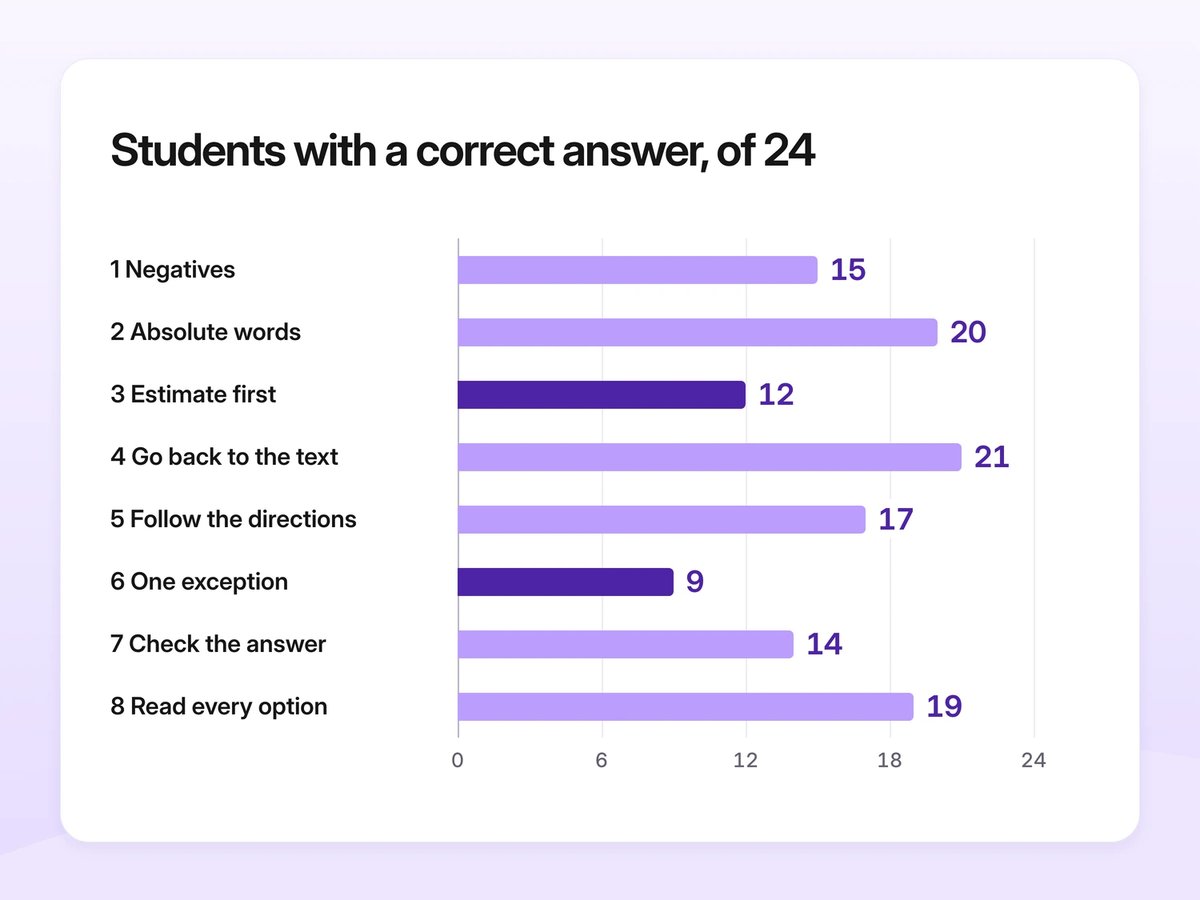
Students with a correct answer, by question
Here, question 6, where one exception breaks an absolute, was answered correctly by 9 of 24, and question 3 on estimating by 12. Those two are the next lesson. Question 4 on reading the sentence went well, with 21, so it can wait. Open the answer counts for question 3. If $10 was the most common wrong answer, ask students what $10 represents here, then have them estimate the amount they would pay. That is a much sharper reteach than a class average of 5.3 out of 8.
Questions teachers ask about test taking strategies
What is the 1/3, 5/7 rule for studying?
It is a popular study-blog rule that says to review new material after 1, 3, 5 and 7 days. No study has tested those exact days. What research supports is spacing: reviewing in several sessions rather than in one.
What are 5 study strategies that work before a test?
Test yourself instead of rereading, spread the review over several days, practice under test conditions, explain the hard parts aloud to someone, and sleep. The first two have the most research behind them.
Can test taking strategies replace studying?
No. Strategies save points a student has already earned, by preventing misreading and bad time use. They cannot supply knowledge that is missing.
How many strategies should I teach at once?
Two per session. A student who tries ten new habits in one test uses none of them well.
Run the pretest this week
Give the eight questions cold, read the results by question and teach the two strategies the class missed. Then ask how the test felt: three questions, answered without names, take minutes to build in Pollsar. Start free, no credit card.