Metacognition: Meaning, Examples and Classroom Strategies
Metacognition is thinking about your own thinking: knowing what you know, noticing in the middle of a task that you have lost the thread, and deciding what to do next. Psychologist John Flavell introduced the term in the 1970s, and his 1979 paper on cognitive monitoring made it a research field.
Below: metacognition explained in plain words and in the form psychology courses expect, examples from class and real life, strategies with ready questions, and a five-minute confidence check that shows how often a confident answer in your class is wrong.
What is metacognition? Definition and meaning
Metacognition means thinking about thinking. A student reads a page, realizes she cannot say what it was about and goes back to the second paragraph. The reading is cognition. Noticing that the reading did not work, and doing something about it, is metacognition.
- Simple definition. Metacognition is awareness of your own thinking and control over it. Some textbooks say knowing about knowing.
- Definition in psychology. Metacognition refers to knowledge about your own cognitive processes together with the ability to monitor and regulate them. Metacognition defined this way is the version most AP Psychology courses, AP Psych for short, and textbooks use.
- Meaning in education. Metacognition in education is a student's awareness of how they learn and the habit of checking and adjusting it while they learn. It is the difference between rereading a chapter three times and stopping to ask which part is still unclear.
It is a skill, not a trait that people have or lack. Everyone has some of it, it grows through childhood and adolescence, and it can be taught. Metamemory, your sense of how well you will remember something tomorrow, is one of its best-studied parts.
The components of metacognition: knowledge and regulation
Theorists such as Gregory Schraw and David Moshman describe metacognition as two parts, and MIT's Teaching + Learning Lab teaches it the same way.
- Metacognitive knowledge is what you know about learning. It covers yourself, such as I understand more when I explain it aloud, the task, such as a lab report needs more planning than a quiz, and strategies, such as summarizing works better for me than highlighting. Flavell's theory of metacognition adds metacognitive experiences, the feelings that arrive mid-task, like the sudden sense that a sentence makes no sense.
- Metacognitive regulation is what you do with that knowledge: plan before starting, monitor while working, evaluate afterward. Teachers sometimes call these habits of mind.
Put regulation in order and you get the metacognition cycle, also called the process, the steps, the model or the framework. No single version is official. A common one has five steps and fits on a classroom poster, an anchor chart or a simple diagram with an arrow from the last step back to the first.
- Set a goal. What exactly am I trying to do?
- Plan. Which strategy will I use, and how will I know it works?
- Monitor. Does this still make sense as I go?
- Adjust. If not, what do I change?
- Evaluate. Afterward, what worked and what will I do differently?
- Reading. A student reaches the bottom of a page, cannot say what it was about and rereads it in smaller pieces.
- Math. Before multiplying 29 by 31, a student estimates about 900, so an answer of 90 or 9,000 sets off an alarm.
- Writing. A student rereads the opening sentence and sees that it never states the claim.
- Studying. A student with a quiz on Friday admits that recognizing terms in her notes is not the same as recalling them, and starts testing herself instead.
- Knowing your limits. A student says, I follow the example, but I could not do one alone yet, and asks for another.
- Real life. You read a recipe, realize you have never separated an egg and watch a video first. Or you catch your mind drifting in a meeting and write down the point you missed.
- Cognition. The thinking itself: you read the problem and calculate. In metacognition vs cognition, metacognition is the part that watches the calculation and asks whether the answer is plausible.
- Critical thinking. Judging claims and arguments from a text or a classmate. Metacognition turns the same judgment on your own reasoning. Checking whether the evidence supports a claim is critical thinking. Noticing that you accepted the claim too quickly is metacognition.
- Self-awareness and introspection. Looking inward at feelings, motives and character. Metacognition looks at how you learn and solve problems, and it ends in an action: change the strategy.
- Reflection. Thinking back after the fact. It is one part of metacognition, the evaluating step. Metacognition also covers planning and monitoring while the work is going on.
- Meta-awareness. Noticing what your mind is doing right now, for example that it wandered. It is the noticing part of monitoring.
- Theory of mind and social metacognition. Theory of mind is understanding what other people think. Metacognition aims the same ability at your own mind, and social metacognition aims it at what a group knows.
- Mindfulness. Noticing thoughts without judging them. Metacognition judges them and steers.
- Emotional intelligence. Reading and managing emotions, your own and other people's. Metacognition reads and manages thinking.
- Self-regulated learning and executive function. Self-regulated learning is the wider habit of setting goals and managing effort, and metacognition supplies the awareness it runs on. Executive function covers planning, attention and impulse control. The two overlap, and researchers still debate where one ends. Cognitive flexibility, the ability to switch strategy, is the part of executive function that metacognition calls on when monitoring says a method is not working.
- Learning styles. The idea that people learn best in one preferred format has not held up in research. Knowing which strategy works for a given task has.
- Students pick study methods that work, such as testing themselves, instead of rereading.
- They ask for help sooner and name what they are stuck on.
- They carry a method from one subject to another.
- They treat a mistake as information instead of hiding it.
- What is this task asking me to do, in my own words?
- What do I already know about it?
- Which strategy will I use, and why that one?
- How will I know it worked?
- Does this still make sense?
- Which part am I stuck on?
- Should I change my approach?
- Is my answer reasonable?
- How sure am I about each answer?
- Which mistake cost me the most, and what caused it?
- What will I do differently next time?
- What is still unclear?
- Think aloud. Solve a problem on the board and say your doubts out loud: I got 90, which seems too small, so I will check. Students rarely see how a skilled problem solver thinks when stuck.
- Muddiest point. At the end of the lesson each student names the least clear part. One sentence is enough.
- Exit ticket. Three questions as students leave: what I understood, what is still unclear, what I will do about it. It is one of the quickest tools in formative assessment.
- Exam wrapper. After a graded test, students answer a short form: how I prepared, which mistakes were careless and which were gaps, what I will change. Pair it with the advice in our guide to test taking strategies.
- Learning journal. Once a week, two lines: what I learned and how I learned it. Older students can turn it into a short reflective essay at the end of the term.
- Predict the score. A simple metacognition game. Before the answers are revealed, each student writes how many of ten they expect to get right. Compare predictions with results over several weeks. Does the gap shrink? That gap is the skill.
- Confidence rating. Beside each answer, students mark how sure they are. It makes the hidden part visible, and the next section runs it with a whole class.
- Reading and reading comprehension. At the end of each paragraph, say its point in one sentence. If you cannot, that is the signal to reread. Skilled readers do this without noticing; many struggling readers need to be told to.
- Writing. Before drafting, state the claim in one sentence. After drafting, underline the sentence that carries it. If none does, revise there first.
- Math. In mathematics the routine is: estimate first, solve second, check third by putting the answer back into the problem. If the answer and the estimate disagree, the slip is in one of them, and the student has found it before the teacher did.
- Science. Predict the result of an experiment, then explain why the surprise happened.
- Physical education. After a drill, students rate how well they could feel their own technique, then compare with a partner's view.
- Sure and right, 9 students. Move on.
- Sure and wrong, 7 students. A misconception: most multiplied distance by time. Ask the class, At 60 km/h, how far would she travel in two hours? The answer, 120 km, contradicts the problem, and students see it themselves.
- Not sure or guessing, but right, 8 students. Fragile knowledge. Ask a similar question in two days, without notes.
- Not sure or guessing, and wrong, 4 students. They know they do not know. Work one example together, then ask for a new estimate.
- Before I start a task, I decide what I want to get out of it.
- I choose a strategy on purpose instead of using the first one that comes to mind.
- I estimate how long a task will take before I start.
- While I read or work, I notice when I have stopped following.
- I stop to check whether my answer is reasonable.
- I can tell the difference between I recognize this and I could explain this.
- After a test or project, I look at why I lost points, not only how many.
- I change my study method when it is not working.
Researchers also talk about levels or types of metacognition. Robert Swartz and David Perkins described four levels of thinkers: tacit, aware, strategic and reflective. Most teaching aims to move a student one step up that ladder, from using a method by accident to choosing it on purpose.
Metacognition examples in class and in real life
Real-world examples of metacognition share one move: someone steps back from the task and looks at how it is going.
Teachers use it too. When a room goes quiet after an explanation, a teacher with strong metacognition asks herself whether the silence means understanding or confusion, and checks before moving on.
Metacognition vs cognition, critical thinking and self-awareness
These terms get mixed up. One task makes the differences clear: solving a word problem.
The revised Bloom's taxonomy by Anderson and Krathwohl lists metacognitive knowledge as one of four kinds of knowledge, next to factual, conceptual and procedural. The levels of Bloom's taxonomy describe what students do with content. Metacognition describes how they manage the doing.
Why metacognition is important for learning
A metacognitive approach to teaching asks students to manage their own learning, not only to receive it. Students who can tell what they do not yet know study the right things. That is the practical benefit of metacognition in learning. The Education Endowment Foundation in England rates metacognition and self-regulation as a high-impact, low-cost approach in its Teaching and Learning Toolkit, and Swanson's 1990 study found that metacognitive knowledge predicted problem solving beyond measured aptitude.
The catch is calibration. Rereading creates a feeling of familiarity that students mistake for knowing, so confidence and accuracy often drift apart. A teacher who collects only right and wrong answers cannot see that gap. Feedback closes it: a student who sees her prediction beside her result adjusts the next one.
Metacognition strategies and activities for the classroom
Teaching metacognition does not need a new unit. It needs one habit: before, during and after a task, students answer a question about their own thinking. These techniques and exercises double as metacognition training, and the prompts work as written, in a learning journal, on a worksheet or in a short form, which collects the whole class's answers at once.
Before the task
During the task
After the task
A three-line sheet covers a whole task and works on paper or in a form. Before: My goal is ___, and I will try ___. During: I noticed ___, so I changed ___. After: I know it helped because ___.
Seven ways to put those questions to work, from the quickest to the most revealing:
Metacognition by subject: reading, writing and math
A metacognition check you can run in five minutes
Accuracy tells you who got it right. It does not tell you how many students are sure and wrong, and a student who is sure does not ask for help. A confidence check puts a second question under each content question: how sure are you? Here is how it plays out in a grade 8 science class.
Say a teacher wants to know whether her class understands average speed. She builds a four-question check. Under every question sits the same one, How sure are you?, with three answers: Sure, Not sure and Guessing. The first question is A cyclist rides 30 km in 2 hours. What is her average speed? with the options 15 km/h, 28 km/h, 32 km/h and 60 km/h.
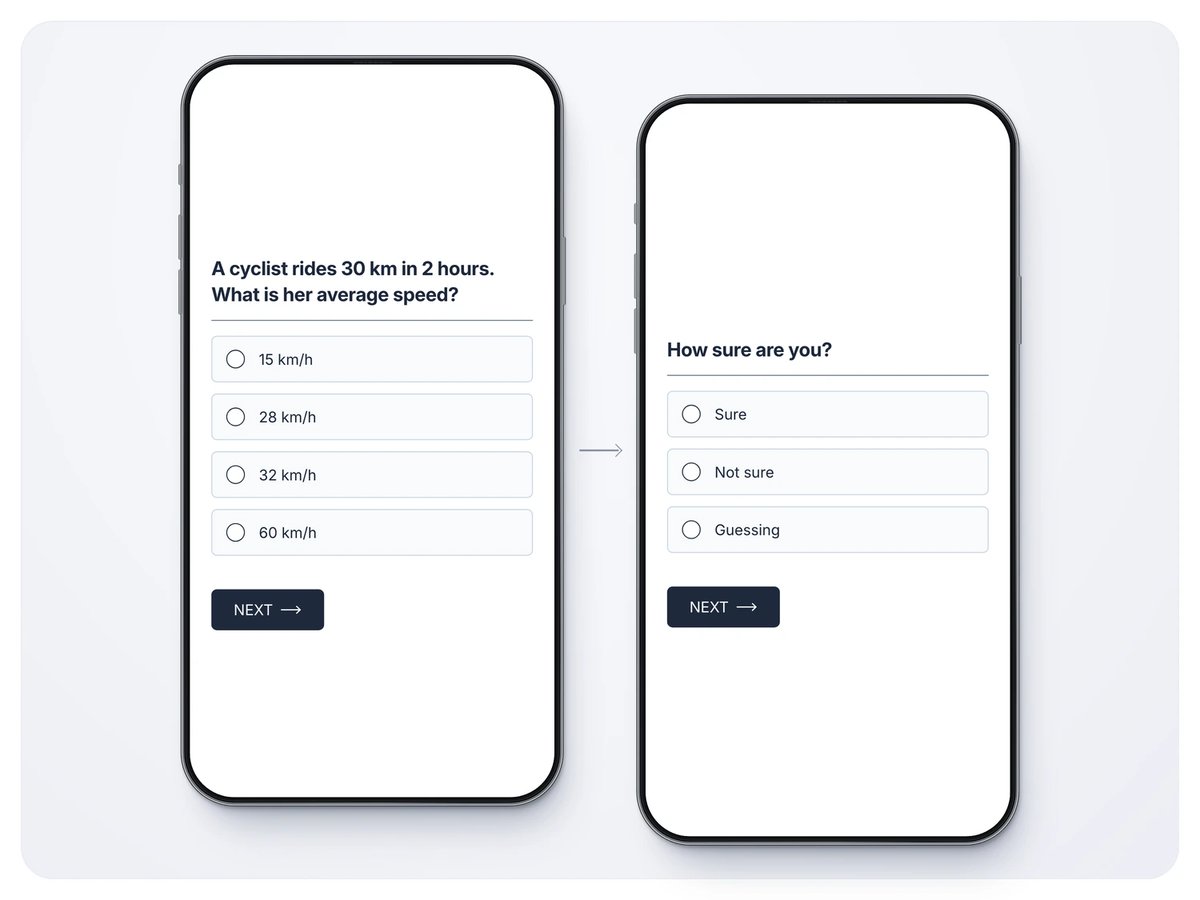
The question and the confidence question, one after the other on a student's phone
In Pollsar she builds the check with the AI assistant and adds one rule to each content question: students who chose 15 km/h go on to one How sure are you? question, everyone else to its twin. On a phone the two look the same. Students open the check without an account and answer without names; she sees the class picture, not who answered what.

Say 28 students answer. On the speed question, 17 pick 15 km/h and 11 pick something else, nine of them 60 km/h. Accuracy says 61 percent, which looks decent. Now put the confidence answers beside it.
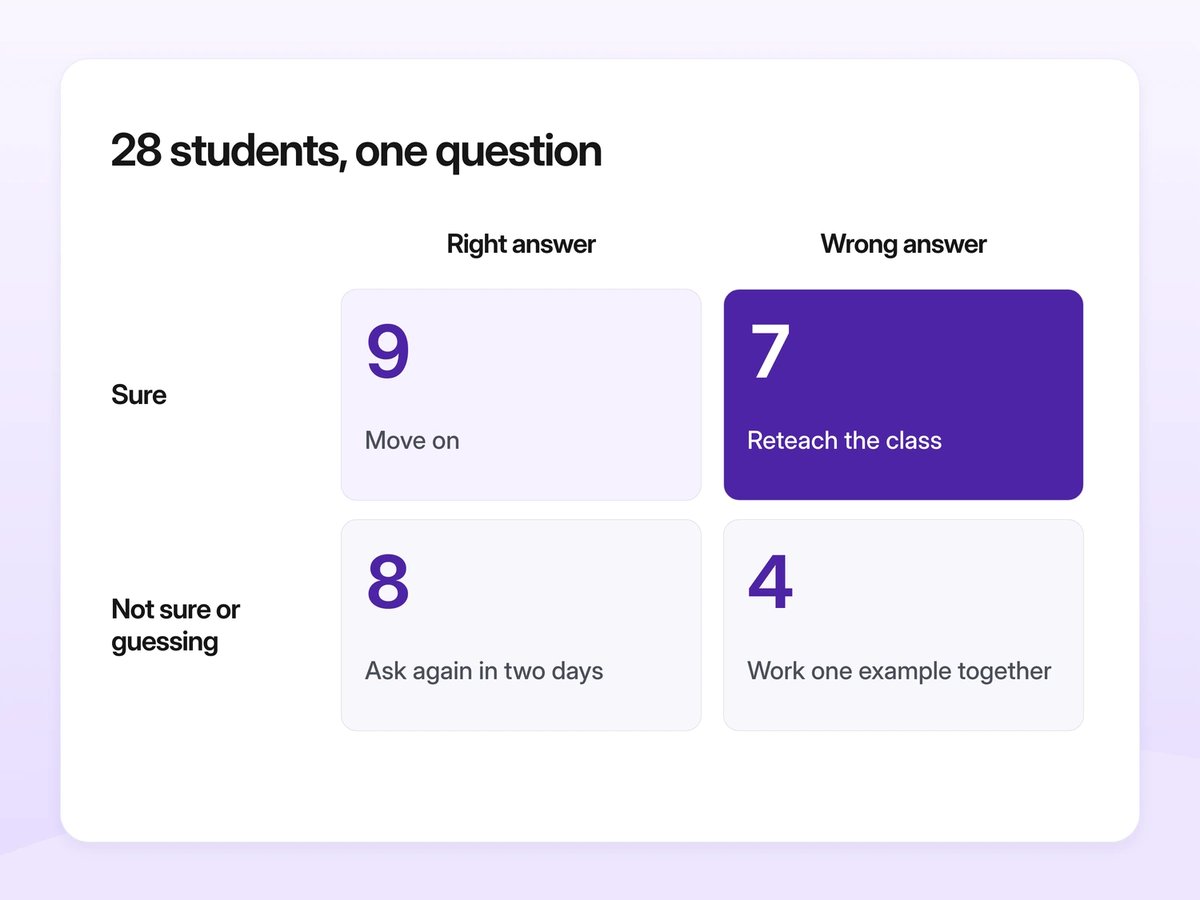
The same 28 answers sorted by confidence and correctness
Without the confidence question the teacher sees 17 right and 11 wrong. With it she sees that seven students were sure of a wrong answer and eight were unsure of a right one. Accuracy alone would have hidden those 15 students.
All of this is on the Results screen while students still have their phones out. The speed question shows how many chose each option. Under it sit the two confidence questions: the one that right answers led to reads Sure 9, Not sure 5, Guessing 3, and its twin for wrong answers reads Sure 7, Not sure 3, Guessing 1. Those are the four groups, counted for her, with no spreadsheet. The survey maker page covers building the check, and the page for teachers has more ways to use forms in a lesson.
Metacognition test: a self-check for your own habits
A metacognition test, quiz or questionnaire shows how you handle your own learning. Researchers use full inventories, such as the 52-item Metacognitive Awareness Inventory by Schraw and Dennison from 1994. Below is a shorter self-assessment in the same spirit for teachers, students 16 and older and adults. It is a reflection tool, not a diagnosis. Rate each statement from 1, rarely, to 5, almost always.
Statements 1 to 3 cover planning, 4 to 6 monitoring and 7 and 8 evaluating. Compare each group with its maximum of 15, 15 and 10. The group with the lowest share is where to practice first. The score summarizes how often you say you use these habits, and habits change.
Low on planning? Answer the four Before the task questions in writing for a week. Low on monitoring? Stop at the end of each paragraph or step and say its point in one sentence. Low on evaluating? Fill in an exam wrapper after every test. That is how to improve metacognition: one habit at a time, checked against results.
How do you measure metacognition in a class? Researchers use self-report inventories like this one, interviews where students think aloud, and calibration, which is how closely confidence follows correctness. The confidence check above measures the last. To run the self-check as a form, the eight statements become eight rating questions, and the guide to Likert scale questions shows how to word and read them.
Questions about metacognition
Is metacognition real, and is it a skill?
Yes. It has been studied since Flavell's work in the 1970s, and it behaves like a skill: it varies between people, improves with practice and can be taught.
Is metacognition related to IQ?
Partly. The two overlap, yet metacognitive knowledge has predicted problem solving beyond aptitude scores in studies such as Swanson's from 1990. A student with a modest test score who monitors well can learn more than the score suggests.
Is metacognition the highest form of intelligence?
No. Researchers treat it as a skill that supports learning, not as a rank above other abilities. Claims that it is the highest form of intelligence have no research behind them.
Is metacognition rare, and how common is it?
Everyone has some. No reliable percentage exists, so distrust any page that quotes one. What differs is how accurate and how deliberate people are, and that differs a lot inside one class.
When does metacognition develop, and can it be taught?
It can be taught at every age. The development of metacognition starts early: simple forms show up in the early school years, such as a child knowing that she forgot something. Jean Piaget's studies of how children think came first, and Flavell worked in that tradition. Strategies and accurate self-monitoring keep improving through adolescence, and explicit teaching helps along the way.
How do I know if I have poor metacognition?
High metacognition looks like checking, adjusting and asking early. The signs of poor metacognition are being surprised by a grade after feeling sure, rereading as the only study method, reading a page without noticing that you lost the thread, and asking for help too late. The self-check above and the confidence check show where it is weaker.
What part of the brain controls metacognition?
No single region controls it. Neuroscience reviews such as Fleming and Dolan from 2012 link metacognitive judgments to the prefrontal cortex.
Is metacognition common in ADHD?
Some research finds that people with ADHD have more difficulty with planning and self-monitoring, which are metacognitive skills. Metacognition is not a sign you can use to diagnose anything. A teacher who is worried about a student should talk to the school psychologist or counselor. The routines above suit every student.
Find out what your class is sure about
Next time a class says it understands, ask how sure it is. Describe the check to the Pollsar AI assistant, put the QR code on the board and watch the answers come in before the bell. Start free, no credit card.