Formative Assessment: What It Is and 12 Ways to Do It
Tuesday, the last ten minutes of a fractions lesson. You ask whether everyone has it, and 24 heads nod. On Friday the unit quiz shows that more than a third of the class adds fractions by adding the tops and the bottoms. Formative assessment moves that discovery from Friday to Tuesday, while you can still change Wednesday's lesson.
Below, one five-question check runs from the whiteboard to the decision it triggers. Twelve techniques follow, sorted by what each one shows you, with three formative assessment templates to copy, then notes for math, writing, science and kindergarten, and an honest list of what formative assessment cannot do.

What formative assessment means: a definition
The word comes from forming: the check shapes teaching while the learning is still being formed. Michael Scriven introduced the pair formative and summative in 1967 for program evaluation, and Benjamin Bloom carried it into classrooms in the early 1970s, which is why older sources say formative evaluation. The purpose is to steer teaching and to give students feedback at a moment when a mistake is still cheap to fix. That is why formative assessment is important, and its main advantage: the gap is found in days, not at the end of the term, and the lesson changes while it can.
Three phrases sit close together. Assessment for learning is the formative check described here. Assessment of learning is summative: it reports what students have learned when the teaching is over. Assessment as learning is students judging their own work. Both of the first two are assessment of learners; what differs is who uses the result and when. The third is where metacognition takes over from the teacher.
Five characteristics of formative assessment follow from that definition, and each one is a benefit in practice:
- It happens during learning, not after it.
- It is low stakes. A wrong answer costs nobody a grade.
- It is quick. A check can take a few minutes, and feedback on a draft can guide a longer revision.
- It is acted on. The result decides the next step, even when the step is to carry on.
- It gives the picture you need. The whole class, a group or one student.
Formative vs summative assessment in short
Educator Robert Stake put it with soup: when the cook tastes it, that is formative; when the guests taste it, that is summative. The cook can still add salt. A summative check, such as a unit test, a final exam or a post-test given after the unit, reports the result and closes the chapter. Diagnostic assessment comes before both and finds what students already know before you start.
The formative assessment process: a cycle and the rule behind it
- Name what students should be able to do by the end of the lesson.
- Pick a quick check that would show it.
- Decide, before you ask, what you will do for each likely result.
- Run the check while students still have the lesson in their heads.
- Read the result by question, not only by student.
- Act on it, then check again to see whether the action worked.
- More than a third of the class: reteach the idea to everyone tomorrow, starting from that mistake.
- One in ten to one in three: pull a small group while the others practice.
- A few students: a two-minute chat or one targeted task in the next lesson.
- Nearly everyone right: skip the review you had planned and move on.
- 1/5 + 2/5. 3/5 · 3/10 · 2/25 · 3/25
- 1/2 + 1/4. 3/4 · 2/6 · 2/4 · 1/8
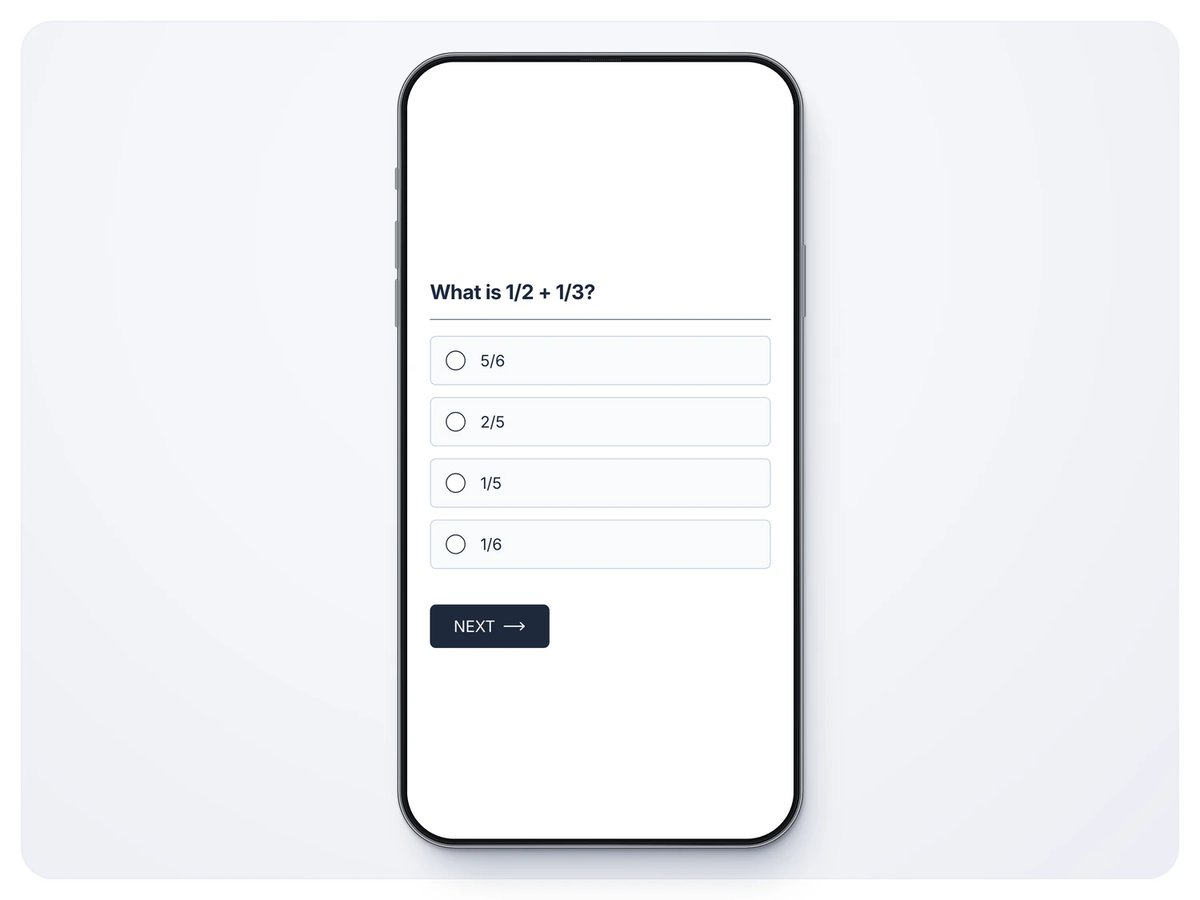
- 1/2 + 1/3. 5/6 · 2/5 · 1/5 · 1/6
- 3/4 + 1/6. 11/12 · 4/10 · 1/8 · 4/24
- Mia ate 1/3 of a pizza and Leo ate 1/4 of the same pizza. How much did they eat together? 7/12 · 2/7 · 1/12 · 2/12
- Brain dump. Two minutes, students write everything they know about the topic. You scan for gaps and for ideas that are plainly false.
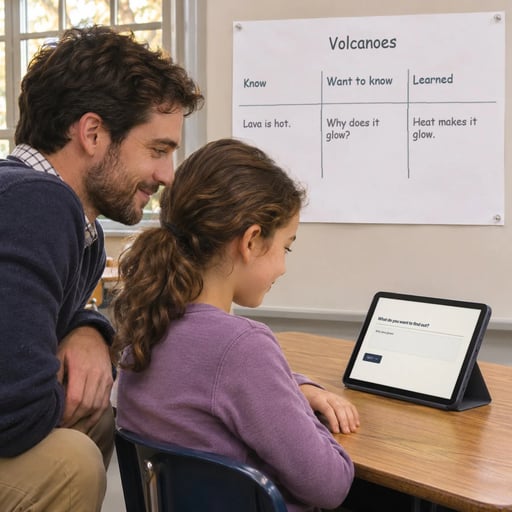
- KWL chart. Know, want to know, learned: the first two columns before the unit, the third after. Comparing the columns shows what the unit changed.
- Fist to five. Students show confidence from zero to five fingers held at the chest, or thumbs up, sideways or down. Ten seconds give you the spread of the class.
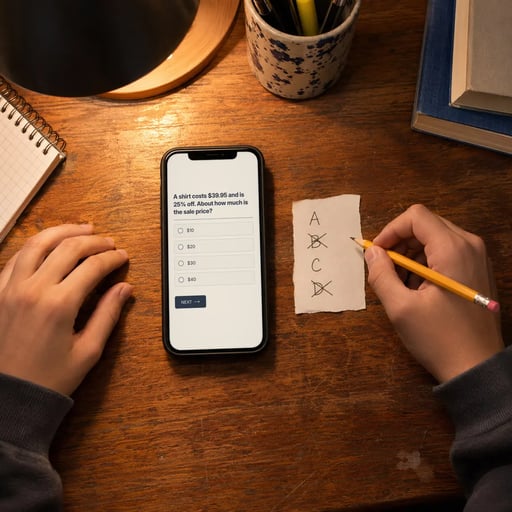
- ABCD cards or mini whiteboards. Everyone shows an answer at the same moment, so nobody waits for the first hand to go up.
- Four corners. Each corner of the room is an answer option, and students walk to the one they choose. Good for young students who need to move.
- Sticky bars. Draw a bar chart on the board with one bar per option, and students stick a note on the bar they choose. The class chart builds itself.
- Exit ticket. One to three questions answered before leaving. The quiz above is an exit ticket with a score.
- 3-2-1. Three things I learned, two that surprised me, one question I still have.
- One-minute paper. What was the main point today, and what is still muddy? Read twenty of them in five minutes.
- Spot the mistake. Show a worked solution with a planted error. Students find the step and say what is wrong with it.
- Teach-back. Partners explain the idea to each other without notes. You listen to three pairs and learn more than from three tests.
- Success checklist. Students check off three or four criteria on their own draft before they hand it in. A rubric works formatively when students get it before the task, not only after.
- Math. In mathematics, write wrong options that each suggest a mistake, as in the example above, or show a worked solution and ask which step is wrong.
- Writing. Ask for one sentence that states the main point of a paragraph. Twenty-four sentences take less time to read than twenty-four essays, and they show who has no point yet.
- Reading. For reading comprehension, stop mid-text and ask for the line that proves the answer, not only the answer.
- Science. Poll a prediction before the demonstration, for example which of two balls lands first, then compare it with what happened.
- Social studies. Give two sources about the same event and ask which one is more reliable and why.
- PE, physical education. Students check each other against three technique cues on a short checklist while you watch the movement.
- Art. A gallery walk with a note for each piece: one thing that works, one question.
- It shows the class picture per question, not only a ranking.
- Students join from a link or QR code on any phone or school tablet, without an account.
- You can write wrong options that each suggest a mistake.
- It scores and routes: a different message for different score ranges.
- It asks nothing personal from students under 16.
- It takes lesson time. Five minutes plus the time to read results. The prepared rule gets most of it back later.
- A right answer can be a guess. A student choosing at random has a one-in-four chance of getting a four-option question right. Follow it with a second question or a why.
- It shows only what you asked. Recall questions will not reveal weak reasoning.
- Students can read it as a test. Say it is not graded, and keep names out of it.
- It does not replace the unit test. It does not certify anything.
- Without a decision, it is noise. Numbers nobody acts on are bookkeeping.
- Is a quiz, homework or a worksheet a formative assessment? Any of them is, when you use the result to change teaching and do not only record it. The same quiz at the end of a unit, graded and filed, is summative. Observation and progress monitoring follow the same test.
- Do I need technology? No. Gestures, cards and exit tickets on paper are formative assessment in full. Technology saves time when many students answer and you want results by question.
Planning a response in advance makes the results easier to act on. Here is an example rule for a lesson plan, by the share of the class that chose the same wrong answer:
The cut-offs are a classroom example, not a research finding. Adjust them to your class size and to how costly the mistake is later. What matters is that the rule exists before the answers arrive. It also saves you from the most common failure of review lessons, which is replaying the whole lesson when one idea went wrong.
A formative assessment example: five questions on fractions
Here is a sample formative assessment you can copy. Say you teach fifth grade, and today's lesson was adding fractions with different denominators. Before anyone leaves, you want to know who can do it and which mistake is going around. A short quiz does both if you write the wrong options with care. Good formative assessment questions ask for one idea each and keep the numbers small. Each wrong answer should come from one specific mistake, so that a student's choice suggests where the thinking slipped.
The questions climb a ladder. Question 1 has the same denominators, question 2 has one denominator that divides the other, question 3 needs a new common denominator, and so on up to a word problem. In question 3, 2/5 is what you get by adding the tops and the bottoms, 1/5 by keeping the top and adding the bottoms, and 1/6 by multiplying. Each wrong answer suggests a different follow-up. Ask for a volunteer who chose 2/5 to show how they got it.
Each correct answer is worth one point, and the quiz adds the points into a score. Wherever a final page says {score}, the student sees their own number. A different final page opens for each score range. Because the students are under 16, the quiz asks for no names or any other personal data: they open the link or scan the QR code from the board and answer on their phones or school tablets, so you see the picture of the class, not who answered what. The final pages therefore do the routing themselves, and the score appears on the student's own screen:


What a student sees on a phone
You do not have to build it by hand. In Pollsar a quiz is a survey with points, so you describe it to the AI assistant in one line, such as five-question multiple-choice quiz on adding fractions with different denominators, one point per correct answer. It drafts the questions and the points. Add three final pages for 0–1, 2–3 and 4–5 points in the builder, and the Publish tab gives you the link and the QR code for the board. The quiz maker shows the whole builder.
Reading the result
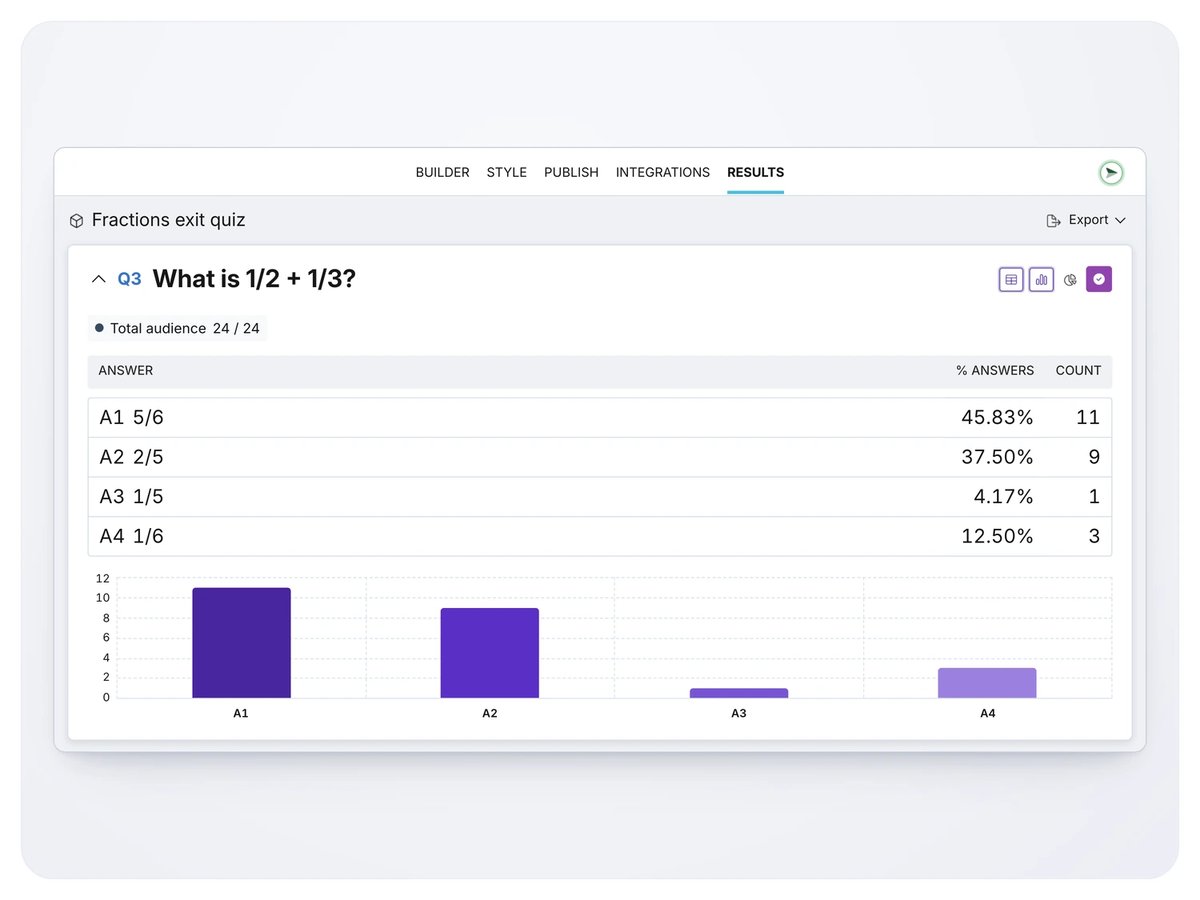
Say 24 students answered. In Results, each question shows a table of its options with counts and a bar chart. Correct answers by question come out as 22, 19, 11, 9 and 8. Read that drop before anything else: adding works, and the idea breaks at the step of finding a common denominator, between questions 2 and 3.
Question 3 after the class has answered
Nine of 24 chose 2/5. That is more than a third, so the rule says everyone gets the idea again tomorrow, and the single mistake behind it is the cheapest kind to fix. Open the lesson with one question: is 1/2 + 1/3 more or less than 1/2, and is 2/5? Three of 24 chose 1/6. That is just over one in ten, so the multiplying mistake gets a targeted task, not a lesson: put 1/2 + 1/3 = 1/6 on the board in the next warm-up and ask the class to spot the mistake. The quiz had no names and needs none, because the students who multiplied will recognize their own step. The single 1/5 waits for that same warm-up. Tomorrow's warm-up is built, and no one needed to grade 24 notebooks tonight.
12 formative assessment strategies and examples, by what you want to see
Before you teach: what do they already know?
During the lesson: are they with me?
At the end: what stuck?
Reasoning: can they explain it?
Types of formative assessment: formal and informal
A formal formative assessment is planned, the same for every student and leaves a record: a short quiz, an exit ticket, a common check. An informal one happens on the fly: a question across the room, a thumbs vote, a walk past the desks. Neither is better. Informal checks give you a signal within seconds, and formal ones give you numbers you can compare across days and classes.
By format, formative assessment methods fall into five kinds: questioning, observation, quick writing, performance tasks and self or peer assessment. A common formative assessment is the formal kind shared by a team. Both fifth-grade teachers use the same fraction question. They compare how often students chose 2/5, agree on a follow-up, and check a fresh example the following week.
Formative assessment by subject and age
For a check that needs no reading or typing, as in kindergarten and preschool, ask aloud, show two pictures, let the children point or show thumbs, and count. A tally on your clipboard is the whole tool, and it records the class, not a child.
Should formative assessment be graded?
Usually not. Once a grade goes into the gradebook, students tend to read the mistake as a loss, not as information. Give the score back as feedback, with a next step, and record the class pattern rather than individual grades. NWEA argues the same in its 2025 article Formative assessment is not for grading. Under standards-based grading, a formative check can count as evidence of progress toward a standard, and the final grade rests on the summative evidence.
The comment matters as much as the score. Good job and needs work tell the student nothing to do. Your common denominator is right; now check the numerators names the next step, and that is the whole job of feedback in this setting.
Digital formative assessment: tools and apps
Paper and gestures do most of the work. A digital or online tool earns its place when the class is large or you want results you can read per question. Check it against five things:
Game-style tools such as Kahoot, presentation tools like Nearpod and Mentimeter, Socrative, Edulastic, Google Forms quizzes and the Formative platform are the formative assessment software most teachers meet, and they fit different habits. Kahoot works for formative review if you ignore the podium and read what each wrong answer says. The tool that is not ideal is the one that shows the winner instead of the misconception: a ranking by speed rewards fast guessing and tells you who was first, not what went wrong. A tool that needs a student account is a poor fit for young children. A Pollsar quiz does all five: results for every question, a link or QR code with no student account, wrong options you write yourself, points with a different final page for each score range, and no personal questions unless you add them. The teacher page shows how it fits a lesson.
What formative assessment cannot do
If you skip it, the first evidence of a gap is the unit test, when there is no time left to repair it. The gap then moves on with the class: fractions that were never solid reappear in ratios a month later.
Where the idea comes from: Black, Wiliam and five strategies
Paul Black and Dylan Wiliam's 1998 booklet Inside the Black Box argued that better formative assessment raises student achievement, and it made the idea a subject of classroom practice. In his 2011 book Embedded Formative Assessment, Wiliam names five strategies: clarify the learning intentions and success criteria, elicit evidence of learning through questions and tasks, give feedback that moves students forward, activate students as resources for one another, and activate them as owners of their own learning. Every example in this article serves one of the five.
Formative assessment FAQ
Build your own check before the next lesson
Take today's topic, write the one mistake you expect, make it a wrong option, and let the AI assistant draft the quiz. You get a link and a QR code for the board before the bell. Start free, no credit card.