Classroom Management Strategies: Pick by Problem, Then Ask Your Class
Most lists of classroom management strategies hand you twenty ideas and no way to choose. This article works the other way around. You name what goes wrong this week, ask your students five short questions, and the lowest score points to the one strategy to change. Two weeks later, ask again and compare how students rate the change.

What are classroom management strategies?
Classroom management strategies, which teachers also call classroom management techniques or tips, are what a teacher does and sets up so that students know what to do, can do it and want to. Strategies for classroom management come in three types, and a good week uses all three.
- Proactive, or preventive, strategies stop problems before they start: clear expectations, routines, a seating plan, work at the right level. Many schools call this tier 1 or universal support, the part every student gets.
- Positive, supportive strategies build the behavior you want: greeting students at the door, specific praise, which is positive reinforcement, and rules stated as what to do. PBIS classroom management strategies, from Positive Behavioral Interventions and Supports, are built on this idea.
- Reactive, or corrective, strategies respond to a broken rule: a look, a quiet word, a reset, a talk after class.
The order below follows the practice guide of the US Institute of Education Sciences: prevent first, teach the behavior you want, respond calmly.
Step 1: ask your class five questions
Lists of strategies are written from the teacher's chair. Students see the same room differently, and they are the fastest source on what is not working. Say you teach grade 7, 28 students, and the room feels loud and slow. Instead of guessing, give them five statements and let students rate each from 1, not true, to 5, completely true.
- I know what is expected of me in this class.
- Moving from one activity to the next is quick.
- I feel respected by my teacher.
- The noise level helps me work.
- The work is not too easy and not too hard.
Each statement stands for one group of strategies, so a low score tells you where to look. All five are worded so that a higher number is better, which keeps the reading simple. This is the format of a Likert scale question, and the same five work as a short questionnaire on classroom management strategies from about grade 3 up; younger classes get the thumbs-up check described below.
You do not have to build it by hand. Describe the check to the Pollsar AI assistant, for example One Multiple Rating question, maximum rating 5. Question text: "Rate each statement from 1, not true, to 5, completely true." Statements, word for word: and paste the five lines. The assistant in the Pollsar survey maker builds the survey with a rating for every statement, and the statements stay the same for round two. Put the link or the QR code on the board. Students answer on their phones or class laptops without an account. The survey asks for no names, emails or anything personal, which matters most for students under 16: they answer without names, and you see the class picture, not who answered what.
In Results every statement shows its average score and how many students gave each rating, and the export menu saves everything to Excel if you want to keep the numbers. Write down the five averages and how many students answered, so you can compare rounds fairly. Use a working rule, which is a suggestion and not a standard: a statement below 3.5 gets attention first, and the lowest one goes first.
A first round, read step by step
- I know what is expected of me: 4.3
- Moving between activities is quick: 2.9
- I feel respected by my teacher: 4.1
- The noise level helps me work: 3.2
- The work is not too easy and not too hard: 3.8
Two statements fall below 3.5: transitions at 2.9 and noise at 3.2. Start with transitions and leave noise alone. If you change both, you cannot tell which change helped. Noise often rises in the gaps between activities, and that is one more reason to begin there. The survey cannot prove it, but your next two weeks can show it. Before you change anything, time one transition on paper: how long from your signal until the class is ready.
Step 2: classroom management strategies by problem
Below, each problem from the check has its strategies, with examples of what to say, written as moves you can use tomorrow. Choose the problem that best matches your classroom, then try one move from that section, and only one.
Students do not know what is expected: expectations
- Write three to five rules in positive words: Walk in place of No running.
- Build the rules with the class in the first week. Students keep rules they helped write.
- Teach a rule like a skill: show it, practice it, correct it, then restate it at the start of each lesson.
Say it like this: Our rule for group work is level one voices. Show me level one.
Transitions take too long: routines
- Name the routine and give it a time: Pack up in one minute. Count down aloud or show a timer on the board.
- Use the same signal for every change, and practice it on the first days until it is boring.
- Keep materials where students reach them without asking, and give each row or table one job.
Say it like this: When the timer ends, books closed and eyes on me. Begin.
Students do not feel respected: relationships
- Greet students at the door, by name. It takes ten seconds and sets the tone before the bell.
- Correct privately, with a quiet word at the desk, not across the room.
- Notice good behavior more often than you correct bad: You waited for your turn, thank you.
This is the heart of positive classroom management strategies. The principle is simple: praise the behavior you want, say what it was, and keep it specific.
The class is noisy or talkative: signals and low-key moves
- Pick one nonverbal signal, a raised hand or a chime, and teach what it means: stop, look, listen.
- Walk toward the noise. Proximity quiets a room faster than a louder voice.
- Give group work a voice level, level 0 to 3, written on the board.
When the whole class is restless, the cause is often energy and not defiance. A two-minute movement pause from the brain breaks collection resets the room better than asking for silence three times.
Work is too easy or too hard: engagement and motivation
- Instructional strategies for classroom management start here: check understanding in the first ten minutes with one question, so you know who needs a different task before they act out.
- Offer two or three task versions of different difficulty, and let students choose.
- Add a game when energy is low. Fun classroom management strategies are only fun if they run on routines, and a good set is in the piece on classroom games.
An exit ticket in the last minutes, one question the class answers without names, shows what the class understood and not who got it wrong. It is a classic form of formative assessment.
Behavior management and discipline strategies: when a student is disruptive
Behavior management classroom strategies are the reactive half. They work best as a ladder: start on the lowest rung and climb only when you must. Use this sequence for routine disruptions such as side conversations or a delayed start, whether the student often tests limits or is just having a bad day. If anyone may be unsafe, follow your school's safety procedure immediately.
- Proximity and eye contact. Walk over and pause beside the desk.
- A nonverbal cue. A raised eyebrow, a tap on the notebook, the agreed signal.
- A quiet redirect. Please open your notebook to page 12. Say what to do, not what to stop.
- A choice. You can work here or at the side table. Which one?
- A private talk after class. What happened, what you need, what will be different tomorrow.
- A call to the family or school support. Use it when a pattern repeats after the earlier steps.
Keep consequences short, calm and the same every time. Publicly shaming a student, punishing the whole class for one person and handing out warnings you do not follow up on are the classic ineffective classroom management strategies, because students learn that the rules move.
Anger, aggression and conflict between students need more than this ladder: they are skills to teach, and that work belongs to social and emotional learning.
Strategies by age and subject
- Preschool and kindergarten. Classroom management strategies for preschool, pre-K and early childhood rooms, Montessori ones included, rest on routine, because preschoolers and other young learners follow what they can see: a picture schedule, a song or chant for each transition, one instruction at a time, and a clear spot on the carpet. In kindergarten, add short jobs for every child. Skip the survey at this age and use a thumbs-up check instead.
- Elementary and primary. Elementary classroom management strategies lean on class jobs, rules in the students' own words, a quiet signal and a short whole-group reset when attention drifts.
- Middle and high school. In the secondary classroom, respect carries most of the load: private corrections, a real reason for each rule, choice in how to show learning and a greeting at the door.
- PE, music and art. Make a stop signal that works in a loud room, and a routine for equipment: who hands it out and who collects it.
- ESL and EFL. Use gestures and pictures for instructions, and repeat the same short phrases for the same routines.
- Online and virtual classrooms. Keep activities short, agree on one signal for attention and one place for questions, and tell students when devices get put away.
- Multigrade and large classes. Teach station routines so that older students can help, and give each group a task they can start without you.
Inclusive classrooms: special education, ADHD and diverse learners
Classroom management strategies for special education, for students with learning disabilities, ADHD or autism, are not a separate list. Clear routines, visual cues, predictable transitions and specific praise help many students and are essential for some. Nothing here is a diagnosis. For a particular student follow the plan agreed with the family and the school support team, and adjust it with them.
Culturally responsive classroom management strategies start from one fact: families teach respect in different ways, and one set of manners is not the only good behavior. Ask about it, notice what a gesture means to the student, and use your class check to hear what students say. For gifted students the best classroom management strategy is work that challenges them, and equitable practice means the same expectation with different support.
Classroom management strategies for new and substitute teachers
- Arrive early and read the plan. Ask the regular teacher or a student which signal the class already uses, then use that one.
- Greet students at the door and put a simple task on the board for the start.
- Use a seating chart, and learn five names in the first ten minutes.
- Keep a calm voice and the same response to everyone. Do not punish the whole class.
- Leave a short note for the regular teacher about how the lesson went.
These classroom management strategies for new teachers, first-year teachers and substitutes, also called supply teachers or subs, rest on one idea. You borrow the class's own routines instead of building yours in one lesson. For professional development, ask a mentor to watch one transition and time it with you.
Build your classroom management plan in six steps
A classroom management plan fits on one page. A six-step approach to classroom management works from kindergarten up; the steps stay, the wording changes with age.
- Expectations. Three to five positive rules.
- Routines. Entering, transitions, materials, finishing and leaving.
- Rewards. What you notice and say, and one class goal, such as five minutes of choice time when the class reaches it.
- Consequences. The ladder above, with a fix attached: you broke it, you repair it.
- Family contact. One short positive message early, before there is a problem.
- Review. Ask the class again every four to six weeks and change one thing.
If you are looking for a classroom management strategies PDF or a ready plan, this one-page sheet is the version to copy into your own document and print. Fill in one line for the problem your class check pointed to.
- Our transition signal: ___
- What students do next: ___
- How we will practice: ___
- What I will observe: ___
- Review date: ___
Step 3: check whether the strategy worked
Two weeks after you introduced the transition routine, give the same five statements again. Give round two its own link, a second audience in the same survey or the same five statements as a new survey, so its answers stay apart from round one. Then set the two sets of averages side by side. Say the averages are now these.
- I know what is expected of me: 4.4
- Moving between activities is quick: 3.9
- I feel respected by my teacher: 4.1
- The noise level helps me work: 3.3
- The work is not too easy and not too hard: 3.7
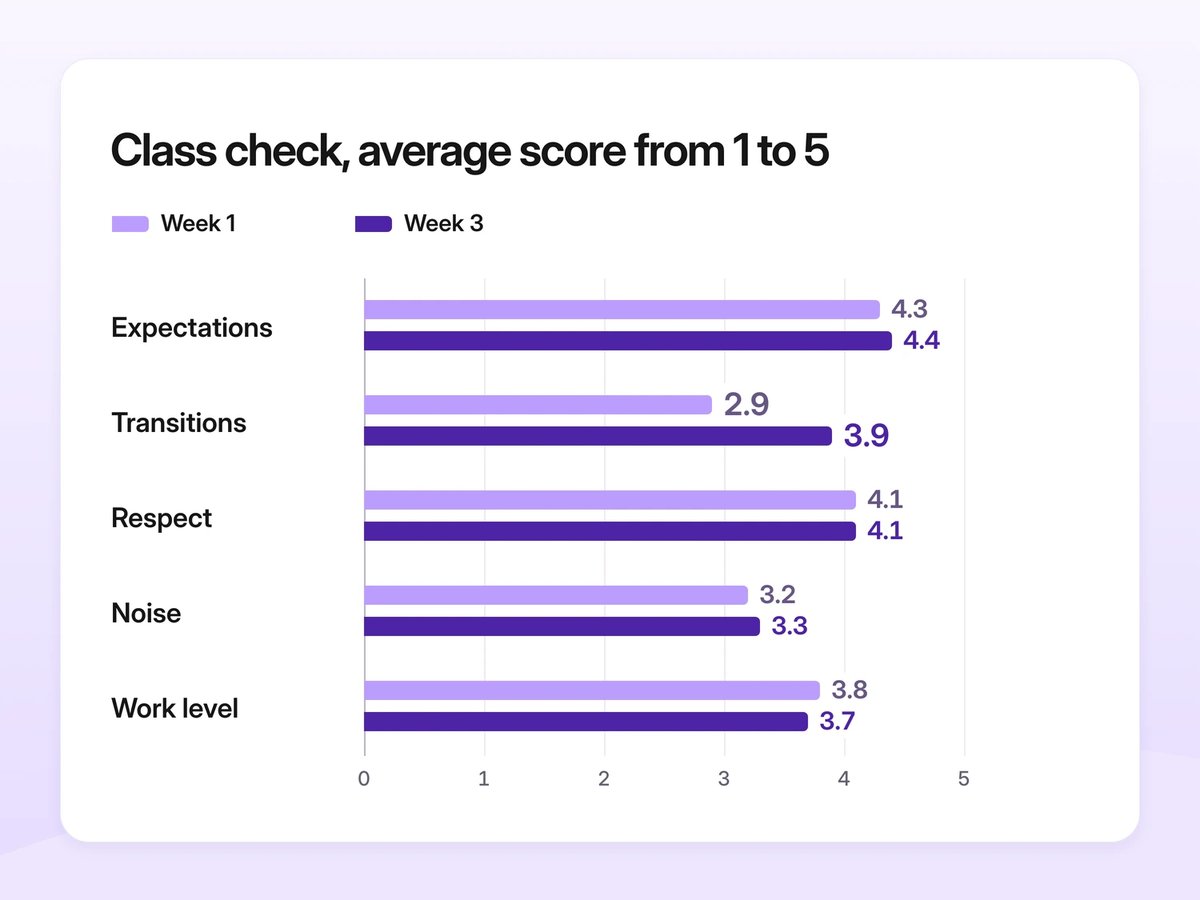
Average score of each statement in week 1 and week 3: only transitions changed by a full point
Transitions went from 2.9 to 3.9, while the other four scores stayed within a tenth. Noise is now the lowest at 3.3, so it is next. Treat the result as direction and not proof: 28 answers and two weeks are small, and other things change in a classroom. You still know where to look, which a list of twenty strategies never told you.
Ratings show how students feel, and the clock shows what happened. Time the same transition again. If it took four minutes in week 1 and takes two now, the ratings and the clock agree, and the routine stays.
Books and evidence behind these strategies
Authors cover the same ground under different names. Robert Marzano's Classroom Management That Works: Research-Based Strategies for Every Teacher, Doug Lemov's Teach Like a Champion, Love and Logic and James Cangelosi's Classroom Management Strategies each offer a model. Classroom management styles run from authoritarian to permissive, and most guides land on the authoritative one: firm about expectations, warm toward students. For evidence based classroom management strategies, the practice guide on reducing behavior problems from the US Institute of Education Sciences is a good source. It advises naming the specific behavior and what comes before and after it, then teaching the behavior you want. Barry Parsonson's evidence-based classroom behaviour management strategies, written for teachers in New Zealand, and Edutopia's short guides to proactive classroom management strategies are two more places to read.
Frequently asked questions
What are the big 8 classroom management strategies?
The big 8 come from the book Class Acts: Every Teacher's Guide to Activate Learning by Gary Forlini, Ellen Williams and Annette Brinkman: setting expectations, time limits, cueing, attention prompts, proximity, signals, voice and tasking. Several of them, expectations, proximity and signals, are already in the problem sections above. Treat the eight as a toolbox, not a plan: your class check shows which one to pick up first.
Which classroom management skills can I practice this week?
A working ten, from the plan above: clear expectations, routines, relationships, specific praise, consistent responses, a calm voice, proximity, a good pace, contact with families and regular reflection. The last one is what the class check gives you.
What is the most effective classroom management strategy?
No single one wins everywhere. The most effective classroom management strategy is the one that fixes your lowest-scoring problem, and it is usually a proactive one such as a routine or a clear rule, because these prevent the problem instead of reacting to it.
Why are classroom management strategies important?
They decide how much of a lesson is learning, and that is their impact on student achievement. A class that knows what to do, and how to start and stop, spends its minutes on the work and not on the waiting. Great classroom management strategies also make school fairer, because every student meets the same expectation.
Do I need a credit card to try the class check?
No. You can start free, build the five-statement survey with the AI assistant and share the link or QR code with your class.
Ask your class before you change anything
Pick the five statements that match your room, describe them to the AI assistant and put the QR code on the board. You get a first picture of the class in minutes, and a second round two weeks later shows how students rate the change. Start free, with no credit card.