Brain Breaks for the Classroom: 30 Quick Ideas and How to Pick the Right One
A brain break is a planned pause of one to five minutes between two tasks. The hard part is not finding one: any teacher can find fifty online. The hard part is picking the right one for this class, at this minute. Hand a loud, jumping break to students who are already wound up and you lose the rest of the lesson. Hand a breathing exercise to a class that has been sitting for forty minutes and they only get stiffer.
So this article does two things. It gives you a way to choose a brain break in about ten seconds, and it gives you a list of 30 brain breaks with examples, sorted by what the class needs, with the time, the noise and the space each one takes. The three types of brain breaks here are wake-up, calm and focus. All 30 are screen-free brain breaks: you lead them aloud or with ordinary classroom supplies, without technology.

What brain breaks are, and why they earn their minutes
The meaning is simple, and the definition fits on one line: a brain break is a short activity that has nothing to do with the task students were just doing. It can be physical, such as a freeze dance. It can be calm, such as slow breathing. It can be a game or a quick puzzle. What counts is that it has a start, an end and a purpose, so the class returns on cue instead of drifting.
Why are brain breaks important for students? The benefits are attention that comes back for the next task, movement in a day of sitting, and one shared routine for switching tasks. The research supporting brain breaks is modest but real. In a study of third and fourth graders in the United States, published in Medicine & Science in Sports & Exercise, short classroom physical activities called Energizers raised on-task behavior by about 8% overall and by 20% among the students who had been least on task, as the 2006 report by Mahar and colleagues shows. It was a small study: on-task behavior was observed in 62 children, and 243 took part in the activity measure. The researchers observed students before and after ten minutes of movement, so read it as a sign that breaks help, not as a promise for your room. How quickly your class settles after a shorter break is something you can watch for yourself.
Pick the break from the class, not from a list
Most lists sort breaks by type. In the middle of a lesson you do not think in types, you think in situations: the room is restless, the room is tense, the room is stuck. Four questions turn the situation into a choice.
- How many minutes can you spare? One minute is a stretch or a breath. Two or three allows a freeze dance or a round of Simon Says. For the breaks in this list, set a timer for one to five minutes. A pause that runs longer, with teams and a winner, is a game, and our article on classroom games covers those.
- May the class be loud? If the room next door is testing, pick a quiet break and say so before you start.
- May students leave their seats? Rows of fixed desks and a hallway line need a different break from an open carpet.
- What does the class need: to wake up, settle or focus? Wake up after long sitting or a heavy lunch. Settle after an argument, a loud recess or a test. Focus before a task that needs careful thinking.
- After lunch or forty minutes of sitting. Wake up: wiggle countdown at the desk, freeze dance if there is room.
- After a loud recess or an argument. Settle: finger breathing, then a heads-down countdown.
- Before a hard task. Focus: buzz on seven or one riddle.
- Right after a test. Settle first, then move: a slow stretch, then mirror partners.
- The room next door is testing. Silent: silent ball or a five senses scan.
- Rainy day, indoor recess. Loud and in place: desk fitness, then freeze dance.
- You cannot tell what the class needs. Ask them: the one-question vote below takes a minute.
- Freeze dance · standing in place. Play music, students dance in place, you stop the music, everyone freezes. A dance-and-freeze round fits a minute or two. Anyone who wobbles does the next round in a silly pose instead of sitting out.
- Wiggle countdown · seated or standing. Shake the right arm ten times, then the left, the right leg, the left leg. Repeat with eight, six, four, two. It ends on its own.
- Crossing the midline · seated. Touch the right hand to the left knee, then the left hand to the right knee, twenty times. Works at a desk.
- Robot dance · standing in place. A funny brain break: students move like dancing robots, stiff and jerky, and switch to a melting robot when you say so.
- Simon Says · seated or standing. Mix quick commands with a few that cross the body. Older students enjoy it when a student leads.
- Desk fitness · standing at the desk. Ten chair squats, ten jumping jacks in place, ten calf raises. Call out the exercises one after another, and skip the counting aloud.
- Four Corners · needs floor space. Name four choices, one per corner of the room. Students walk to a corner and justify the choice in one sentence.
- Heads Up, Seven Up · needs floor space. The class puts heads down and thumbs up. Seven students walk around, each presses one thumb down, and the chosen students stand and guess who picked them. A classic for a lower grade with floor space.
- Stand if · at the desk. Read statements about the class such as Stand if you walked to school today. Students stand or stay seated. It takes no preparation.
- Mirror partners · seated. Pairs face each other, one leads, one copies, then swap. Quiet and active at once.
- Animal walks · needs floor space. Bear crawl to the door, frog jump back, crab walk on the carpet. Preschoolers and kindergartners love it, and PE teachers use the same moves for warm-ups.
- Bubble breathing · seated. Breathe in through the nose, blow out slowly as if filling a big bubble, hold the bubble still for a moment, pop it with a quiet clap. Five rounds.
- Finger breathing · seated. Trace one hand with a finger of the other: up a finger as you breathe in, down as you breathe out. Five fingers make one round.
- Silent ball · seated in a circle or rows. Students pass a soft ball without a word. Drop it or throw badly and you simply sit for the next round.
- Five senses scan · seated. A mindfulness classic: name silently five things you see, four you feel, three you hear, two you smell, one you taste.
- Slow stretch · seated or standing. Reach up, fold forward, roll the shoulders, and hold each position for a slow count of five. No special poses needed.
- Wall push-ups · clear wall space. Students stand an arm's length from a clear wall and push slowly ten times. It is a sensory brain break borrowed from occupational therapy, and many classes use it for students who need to feel calmer.
- Doodle with eyes closed · seated. Students draw a house or a face on paper without looking, then open their eyes and laugh quietly. A small art break and a creative one.
- Heads-down countdown · seated. Everyone puts their head on the desk and counts backward from twenty in their head. A short silent break for a whole class.
- Quiet music · seated. One minute of calm instrumental music with heads down, the simplest way to use relaxing music for the classroom.
- Buzz on seven · seated. Count up by ones around the room. Say buzz instead of 7, 14, 21 and each later multiple of seven. Change the number to suit the grade.
- A to Z categories · seated. Name a category such as animals and go through the alphabet, a student per letter, until stuck.
- Simón dice · seated or standing. For Spanish class: Simon Says with body parts and commands in Spanish. Students who know the word move faster than those who guess.
- Be the water cycle · standing in place. In science, act out evaporation, clouds and rain with your arms. Any process in a unit works.
- Act out the word · at the front. In reading, a student mimes a vocabulary word and the class guesses it.
- Rock, paper, scissors battle · seated or standing. Everyone plays a neighbor for three quick rounds, then stops on the signal.
- Would you rather · needs floor space. Read Would you rather be able to run very fast or jump very high?, and students walk to the left or right side of the room. Do the same with this or that choices: pizza or tacos, beach or mountains.
- Memory chain · seated. The first student says a word, the next repeats it and adds one. Stop when the chain breaks.
- Riddle of the day · seated. Read one riddle and let pairs whisper an answer. Easy to prepare and fun for a whole class.
- Kind word · seated. Each student tells their partner one thing that went well today. A quick SEL brain break that costs nothing.
- Would you rather have a tail or wings?
- Live in a treehouse or on a boat?
- Be able to talk to animals or speak every language?
- Eat only breakfast food or only dinner food?
- Explore the ocean or outer space?
- Be ten minutes early or ten minutes late?
- Have a pet dinosaur the size of a cat or a cat the size of a dinosaur?
- Never do homework or never do chores?
- What is 7 × 8? Answers: 54 · 56 · 63 · 48. Key: 56.
- What is 6 × 9 minus 4? Answers: 50 · 54 · 45 · 58. Key: 50.
- What comes next: 3, 6, 12, 24? Answers: 36 · 30 · 48 · 27. Key: 48.
- Preschool and pre-K. Brain breaks for preschoolers are one minute and one move, and you do it with them: animal walks, wiggle countdown, bubble breathing. Children follow your body better than your words, so show first, and put a quiet break between two noisy ones.
- Kindergarten. The best brain breaks for kindergarten last one or two minutes and have one rule. To wake up: freeze dance, animal walks, wiggle countdown. For calming: bubble breathing, finger breathing, a heads-down countdown. For fun: stand if. For a math break: count ten jumps aloud together.
- First, second and third grade. Three minutes, with rules a seven-year-old can hold in mind. Freeze dance, Simon Says, Heads Up, Seven Up and Stand if all work; for calm, try the five senses scan or silent ball.
- Fourth and fifth grade, upper elementary. Add some quiet competition: buzz on seven, A to Z categories, the three math puzzles above. In England this is roughly key stage 2.
- Middle schoolers, sixth grade and up. Short, a bit ironic and never babyish: Four Corners, would you rather, doodling with eyes closed. Let a student run it.
- High schoolers and adolescents. One or two minutes: a slow stretch, quiet music, stand if, or a quick vote. Older students accept a break when it is honest and brief, and resist it when it sounds like a kindergarten song.
- Hallway. Waiting in a line: I Spy with colors, count the steps, whisper a tongue twister. One minute, no noise.
- Indoor recess. Rainy days need a loud break to burn off energy: freeze dance, desk fitness, a relay with soft balls.
- Zoom and virtual classroom. Online brain breaks are short: ask everyone to find something blue in the room and bring it to the camera, or stand up and stretch with cameras off. This also covers distance learning and remote learning breaks.
- Homeschool. The same ideas work with siblings of different ages: pair the older child with the younger for mirror games.
- Teacher breaks. You need one too. Two minutes of slow breathing while students read silently is a break for teachers that keeps you steady for the next lesson.
- Winter, snow. Snowball toss: crumpled paper into a basket.
- Spring: March, April, May. Grow like a seed, from a crouch to a full stretch.
- Fall. Leaf float: drift slowly to the floor.
- Summer. Swim in place for thirty seconds.
- Earth Day. Recycling sort: point at the right bin when you name an item.
- Space. Slow-motion astronaut walk.
- Dinosaur. Stomp, then tiptoe like a small one.
- Camping. Pitch an imaginary tent, then sit and listen for forest sounds.
- Ice cream. Scoop, stack and melt slowly.
- Superhero. Three strong poses held for ten seconds.
- Announce the length. Two minutes, starting now ends the argument before it starts.
- Use one signal to return. A chime, a hand up, a countdown from five. The same signal every time.
- Let students scale it down. Students may stay seated, watch or use a smaller movement. Forcing participation turns a break into a task.
- Name the break after it. Say what kind it was and what comes next, so students learn which breaks wake them and which calm them.
- Keep a record of what works. The class check-in gives you the numbers, and a note of two words per day is enough.
If students need to move and must stay seated, try mirror partners. If they need quiet and have one minute, trace one hand as you breathe. Write your four answers on a sticky note and keep it on your desk.
The ideas below are grouped by what the class needs, and each idea names the space it takes.
Wake-up breaks: movement for restless classes
One to two minutes · loud is fine. Each idea names its space. Use these energizing brain breaks after long sitting, a heavy lunch or a rainy indoor recess. Movement breaks are the easiest to overrun, so set a timer before you start.
Calm breaks: quiet, silent and de-escalating
One to three minutes · quiet. Each idea names its space. Use these calming, mindful brain breaks after an argument, a test or a loud transition. They are the first thing to try when a student is getting upset: nobody can be shouted into calm, and a slow breath you take together does the job.
Focus breaks: a small task that switches the brain
Two to five minutes · low noise. Each idea names its space. These are breaks with a task: educational brain breaks that change the kind of thinking instead of stopping thinking. They suit the moment before a hard lesson, when you need students curious rather than tired.
Here are eight would you rather questions to start with: left side of the room for the first choice, right side for the second.
Let the class vote on the break
There is a gap in almost every list: nobody asks the class. Yet the students know whether their legs are itching to move or their heads are full. With devices already open, make it an interactive brain break: ask students to choose one of four breaks. For a faster offline vote, show four picture cards.
Here is how it can run. Say a fourth-grade class of 25 has just finished a long reading block. You put one question on the board: What does your brain want right now? with four answers: Move · Quiet · A game · A brain teaser. Students answer on a tablet, a school laptop or a phone, and nobody types a name. Say 12 pick Move, 7 pick Quiet, 4 pick A game and 2 pick A brain teaser. You glance at the summary on your own screen, see that nearly half want to move, and run a two-minute freeze dance. The seven who wanted quiet get the next break, a slow one after the dance. Nobody argued, and everybody had a say.
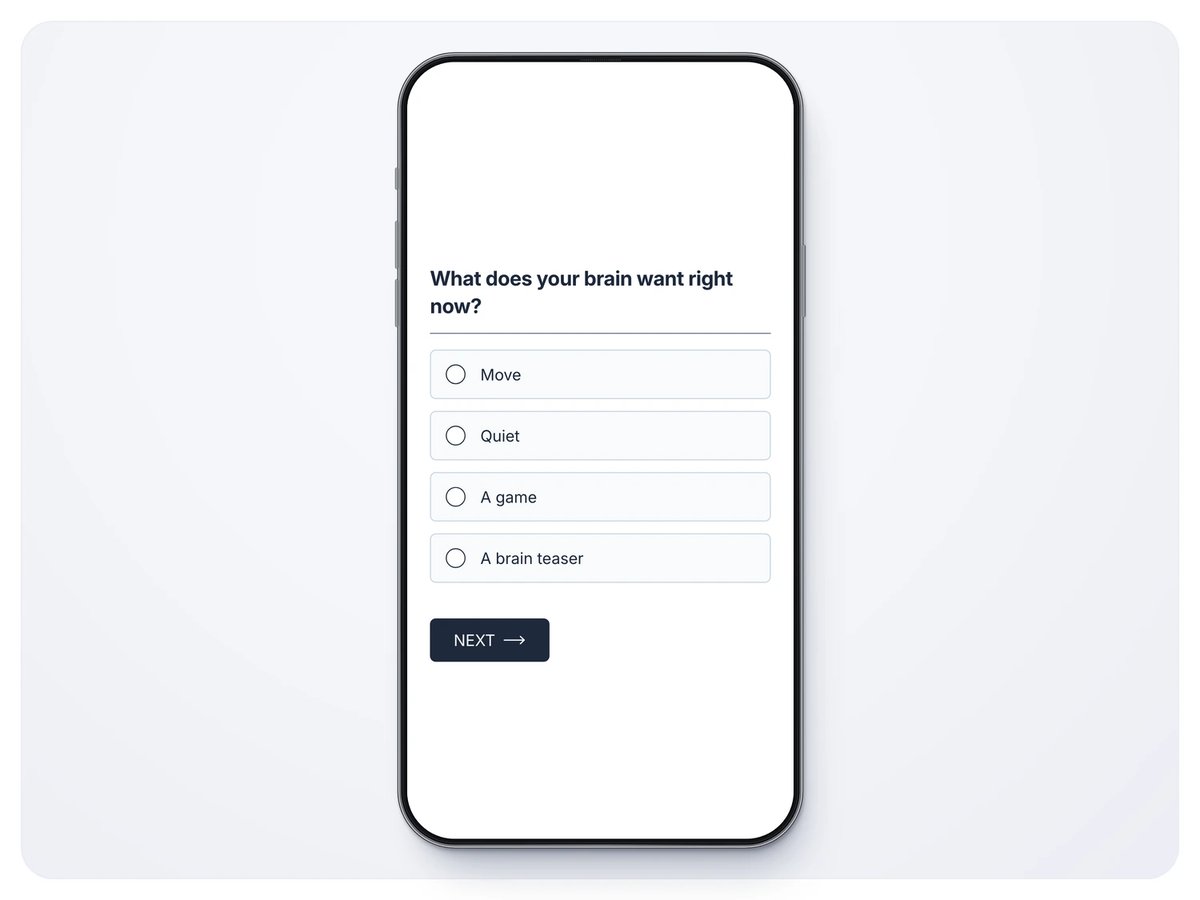
The check-in question as a student sees it on a phone
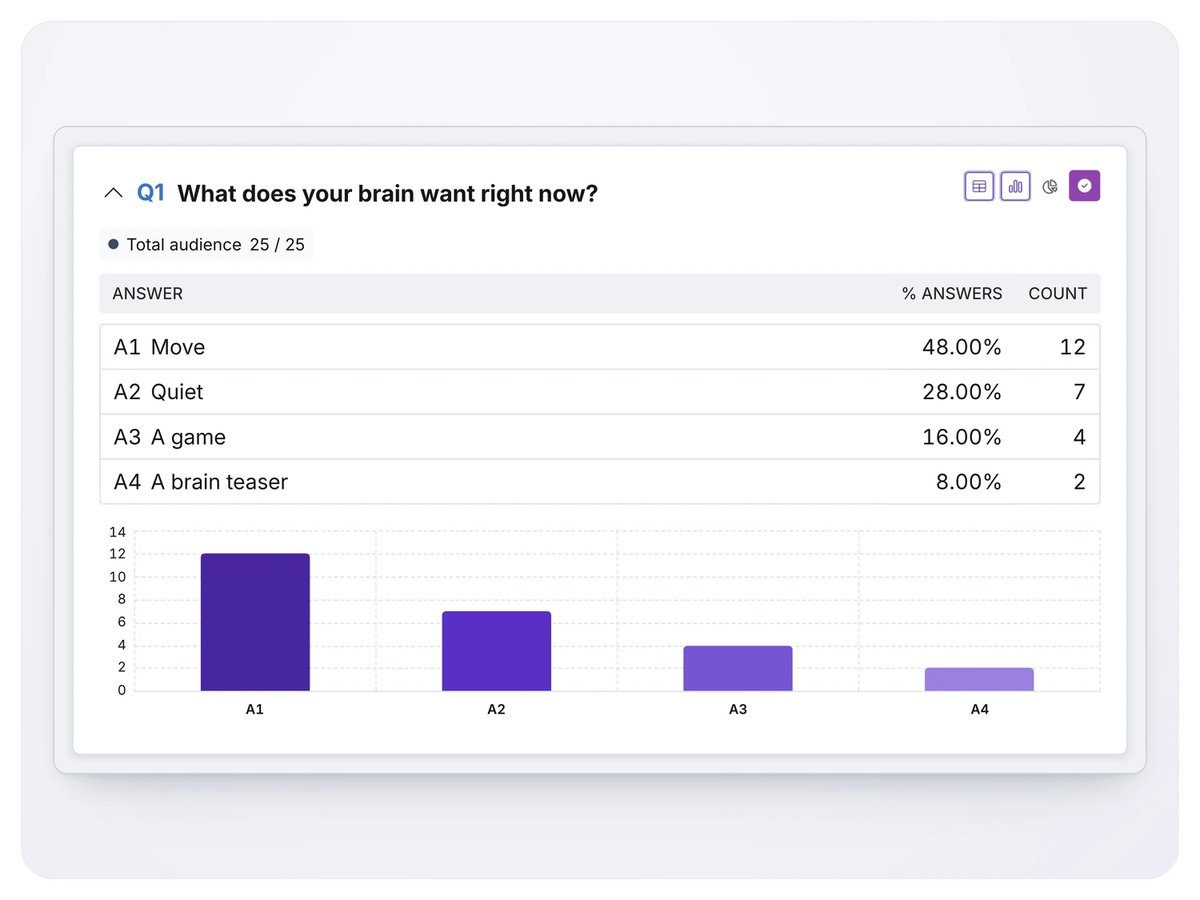
The class picture on the teacher's screen: 25 answers, no names
In Pollsar you can describe this to the AI assistant in one line, such as One question for a fourth-grade class: What does your brain want right now? Four answers: Move, Quiet, A game, A brain teaser, and the assistant builds the survey. You publish it, show the QR code on the screen, and the class answers without an account. Use only the four preset choices and leave out names, email addresses and identifying details. Students answer without names, so you see the class picture and not who answered what, which is the right setup for any class of students under 16. The same survey works again next week, so you can see which kind of break your class asks for most. More ideas for classroom surveys live on the page for teachers.
With kindergarten and first grade, skip the screens. Put four picture cards on the wall, one for each choice, and let children walk to the card they want. You count the groups at a glance, and the walk is already a small break.
Math brain breaks: three puzzles read aloud
Math brain breaks, and breaks for math class generally, work best when they feel like a puzzle and not like a worksheet. Three puzzles fit between two lessons. Say you teach fourth grade. Read them aloud or put them on the board:
Let pairs compare answers, then give the key: 56, 50, 48. Want the same three puzzles on students' screens with the points counted for you? Build them in the quiz maker: each student sees a score on the last page, and you see every score in Results, without names.
Brain breaks by grade: kindergarten to high school
If your class is mixed, put the same choice to them every week and see which kind wins. Ask them: older students may choose a calm break more often than you would guess.
Breaks for special rooms: hallway, indoor recess, online
Seasonal and themed brain breaks
Themes make a break feel new without changing it. Use whatever the school week offers, from January to May, and keep the same few moves underneath.
Videos, songs and printables
YouTube brain breaks, dance videos and action songs suit the moments when you want a leader on screen. Channels like Danny Go and GoNoodle make brain break videos and songs that children follow easily. Keep any video under five minutes and watch it yourself before class, because the comments and suggested videos around it are not always suitable for children.
For printed material, write your favorite ten breaks on index cards, add a simple drawing or a clipart picture, and put them in a jar. A student draws one at random, which also hands part of the choice to the class. Brain break cards, printables, books and Pinterest boards offer endless variants, and in the end you need only ten good brain breaks that you can run without thinking.
Running a brain break without losing the class
Never use a break as a reward to earn or a punishment to lose. Students who most need to move are often the ones who lose breaks, so protect them. For wider routines, see our article on classroom management strategies.
Questions teachers ask about brain breaks
What are the pros and cons of brain breaks in the classroom?
The pros are better attention after the pause, more movement in the school day and a shared routine that helps transitions. The cons are lost minutes, a class that struggles to settle again and breaks that are too long or too exciting. All three cons come from the same mistake: the wrong break at the wrong time. Pick by the four questions and keep to the timer.
How long should brain breaks be?
One to five minutes. Think in 1 minute brain breaks for a stretch or a breath, 2 minute or 3 minute brain breaks for a freeze dance, and 5 minute brain breaks for a task with a small puzzle. A 10 minute brain break with a score is a game rather than a break.
Are brain breaks useful for students with ADHD?
Predictable, scheduled movement helps many students who find it hard to sit still, and sensory or occupational therapy breaks suit some. Plans for an individual student belong to the school team and the family, so use this article for the whole class and do not store notes about a child's behavior or health online.
Where can I find free brain breaks and a brain breaks website?
Video channels such as GoNoodle and Danny Go, catalog sites with filters by length and age such as BrainBreak Hub, and this page: every idea here is free to copy and needs no app. For a class vote, you can start free with Pollsar.
Do brain breaks work for older students and adults?
Yes, with a lighter tone. A minute of stretching, music or a quick vote does for a high school class what a freeze dance does in second grade. Keep it short and give students a choice.
Run your class check-in this week
Pick one question, put it on the board and let the class choose the next break. Describe it to Pollsar's AI assistant, show the QR code, and read the result on your own screen before you pick. It is free to start, no card needed, and the whole thing is shorter than a brain break.