What Is a Rubric? Meaning, Types, Examples and How to Make One
A rubric is a scoring guide: a list of what a piece of work is judged on, with a description of what each level of quality looks like. The same rubric definition works for an essay, a science talk or a team project. The word comes from the Latin for red ochre, the color scribes used for headings and instructions in manuscripts. In school, the meaning of a rubric is practical: it tells the student what counts and tells you how to score it.
Below you get the three types of rubrics and a rule for choosing one, five steps for writing your own, a finished rubric for an oral presentation scored on a sample science talk, criteria for the assignments teachers grade most, and an honest list of what rubrics get wrong. Rubrics from testing organizations and teacher-evaluation frameworks are a different subject; a note after the examples explains where to find them.
What is a rubric in education?
In teaching, a rubric answers one question before the work starts: what does good look like here? A rubric names criteria and describes what meeting them looks like. A scored analytic rubric also assigns levels and points. Its parts are these.
- Criteria. The things you judge, such as content, structure and delivery.
- Levels. The steps of quality, usually three or four, named for the work: Starting, Developing, Proficient, Advanced.
- Descriptors. One sentence for each criterion at each level, saying what you would see or hear in the work.
- Points or weights. The number each level earns. Points turn a rubric into a scoring rubric, also called a grading rubric, and the sum is the rubric score.
A rubric is not an answer key. A key has one right answer; a rubric describes a range, which is why it suits essays, talks, projects, art and every task where good answers differ. It works in both directions. Students read the criteria before they start, and you apply the same yardstick to the first piece of work and the thirtieth.
Types of rubrics: analytic, holistic and single-point
Three types cover almost every classroom. They differ in how much you write in advance and how much feedback comes out the other end.
Analytic rubric
Rows are criteria, columns are levels, every cell has a descriptor, and each criterion is scored on its own. The scores add up to a total. It takes the longest to write and gives the sharpest picture: a student sees Delivery: Developing right beside Content: Advanced. It suits work you grade by the dozen and score with points.
Holistic rubric
One scale for the whole piece of work: a single description per level, and you pick the level that fits best overall. A holistic rubric takes minutes to apply and little to write, but the student gets one level and few clues about what to change. It suits quick final judgments, such as a short written response.

Single-point rubric
Only the target is described. Each criterion has the standard in the middle, an empty column on its left for work that falls short and one on its right for work that goes beyond. You write comments instead of choosing levels. It is quick to write and the feedback is in your own words, but it carries no points, so it fits drafts and conferences more than a final score. Teachers also call it a one-point rubric.
Use a checklist when you only need to record whether each element is present, such as a title and a list of sources. It has two levels, done or not yet. A 2-point rubric is a different small tool: state tests such as Indiana's and Texas's score a short written answer 2, 1 or 0.
Which type of rubric to choose
Lists of types are everywhere. The rule for choosing is rarely written down. Ask two questions: do you need points, and who will act on the feedback?
- Many pieces of work and points needed: analytic.
- Fast overall judgment, little feedback needed: holistic.
- A draft, a conference, feedback the student will act on: single-point.
- Steps that are present or absent: checklist.
Mixing is fine. A common pattern is a single-point rubric on the draft and an analytic one with points on the final version, with the same criteria in both so the student can see the distance traveled.
How to make a rubric in five steps
Creating a rubric is mostly deciding, not formatting. Say the task is a three-minute science talk in grade 8. We will build that rubric from the first step to a scored talk.
- Start from the goal. Finish the sentence After this task a student can… Here: explain one scientific idea so that classmates can repeat it. Every criterion must serve that sentence.
- Pick three to five criteria. Content, structure, delivery, visuals. With more than five you cannot hold them in your head while the student talks; with fewer than three the rubric says too little.
- Choose the type and the levels. There are about 28 talks to score and you need points, so: analytic, four levels, Starting, Developing, Proficient, Advanced. Four levels leave no safe middle.
- Write the Proficient level first, in what you can see. Then describe the levels on either side of it. Name behavior, not impressions.
- Weight it, test it, fix it. Content is the point of the task, so it counts double. Then score two or three old pieces of work with the draft. Wherever you hesitate, a descriptor is vague.
- Advanced, 4 × 2: Every claim is correct and explained with an example, and the talk goes beyond the textbook.
- Proficient, 3 × 2: Claims are correct and each one has a reason or an example.
- Developing, 2 × 2: Mostly correct, but some claims have no reason, or one is wrong.
- Starting, 1 × 2: Several claims are wrong or missing, and the idea is not explained.
- Advanced, 4: An opening question, a clear order and a closing sentence that repeats the main idea.
- Proficient, 3: A clear beginning, middle and end.
- Developing, 2: The order is hard to follow in one place.
- Starting, 1: Ideas come in no clear order.
- Advanced, 4: A clear voice and steady pace, eyes on the audience, notes only glanced at.
- Proficient, 3: Heard at the back of the room, reads from notes at times.
- Developing, 2: Quiet or rushed in places, mostly reads from notes.
- Starting, 1: Hard to hear, reads everything.
- Advanced, 4: Each slide or poster supports one point and is readable from the back, with a diagram that explains something words cannot.
- Proficient, 3: Slides support the talk and are readable.
- Developing, 2: Slides repeat the talk word for word or are hard to read.
- Starting, 1: No visual, or it does not match the talk.
- 17 to 20, Advanced: Excellent talk. Next stretch: answer one question from the audience.
- 13 to 16, Proficient: Solid. Review your four criteria and choose one skill to practice before your next talk.
- 9 to 12, Developing: The idea is there. Rehearse once with a classmate and try again.
- 5 to 8, Starting: Meet with me for five minutes and we will rebuild the order of the talk together.
- Argumentative essay rubric: claim, evidence, reasoning, organization, conventions.
- Synthesis essay rubric: position, use of several sources, how the sources are combined, organization, conventions.
- Rhetorical analysis rubric: claim about the author's choices, evidence from the text, explanation of the effect, organization.
- Research paper or research report rubric: research question, quality of sources, evidence, citations, organization, writing.
- Narrative writing rubric: story idea, characters and setting, order of events, word choice, conventions.
- Six traits of writing rubric: one criterion for each trait: ideas, organization, voice, word choice, sentence fluency, conventions.
- Kindergarten writing rubric: the message matches the picture, letters stand for sounds, words are separated by spaces.
- CER rubric: claim, evidence, reasoning, one criterion each.
- RACE or RACER rubric: one criterion for each step: restate, answer, cite, explain, plus review in RACER.
- Project, poster or one-pager rubric: the idea is clear at a glance, accuracy, readable design, sources named, finished on time.
- Debate rubric: claims, rebuttal, evidence, listening, speaking etiquette.
- Socratic seminar or textual conversation rubric: preparation with notes in the text, quality of questions, using the text to back a point, listening and building on others.
- Interview rubric: preparation, quality of questions, listening and follow-up, summary of the answers.
- Art or artwork rubric: technique, use of what the lesson taught, idea, craftsmanship.
- Team rubric for group work: own contribution, sharing the load, listening, the finished product.
- Claim. Developing: states a position. Proficient: states a position that someone could disagree with.
- Evidence. Developing: cites evidence. Proficient: explains how the evidence supports the claim.
- Reasoning. Developing: repeats the evidence. Proficient: connects the evidence to the claim with a because.
- Organization. Developing: paragraphs in a loose order. Proficient: one point per paragraph, in an order that builds.
- Conventions. Developing: errors slow the reader. Proficient: errors are few and do not slow the reader.
- One yardstick. The first piece of work and the last are judged by the same criteria, which makes scoring fairer and easier to explain to a parent.
- Students know the target. They read the criteria before they start, so you answer fewer questions like what do you want?
- Faster feedback. You choose a level instead of writing a paragraph, and the descriptor does the explaining.
- It takes time to write. Write it once per type of assignment and reuse it. Next term only the content row changes.
- Students treat it as a checklist and stop at Proficient. Make the top level about thinking, not about more length, and use a single-point rubric on drafts.
- Vague descriptors cause arguments. Describe what can be seen or heard and test the rubric on old work.
- Good work that does not fit gets lost. Leave one open comment field and read the work as a whole once before you score.
- Too many cells, and nobody reads it. Keep to three to five criteria and short descriptors.
Descriptors are where rubrics succeed or fail, so here are two pairs. Good voice becomes Speaks loudly enough for the back row and looks at the audience most of the time: two teachers will agree on the second sentence and argue about the first. Shows creativity becomes Includes one example the class has not seen before: now the student knows what to add. When a criterion is about thinking rather than form, choose the verb with care; lists and explains sit on different steps of Bloom's taxonomy, and the descriptor should say which one you expect.
Rubric example: oral presentation rubric with points
Here is the finished rubric for the talk. Levels earn 1 to 4 points and Content is doubled, so a talk scores from 5 to 20.
Content, counts double
Structure
Delivery
Visuals
Scoring one talk with the rubric
Say the speaker of talk 7 explains each claim with an accurate example. The back row hears the opening, but the speaker reads the rest quickly from notes. That earns Proficient for Content and Developing for Delivery; Structure is Advanced and Visuals Proficient. The points are 3 × 2 = 6, plus 4, plus 2, plus 3, so 15 out of 20. Four ranges decide the comment that goes with the score.
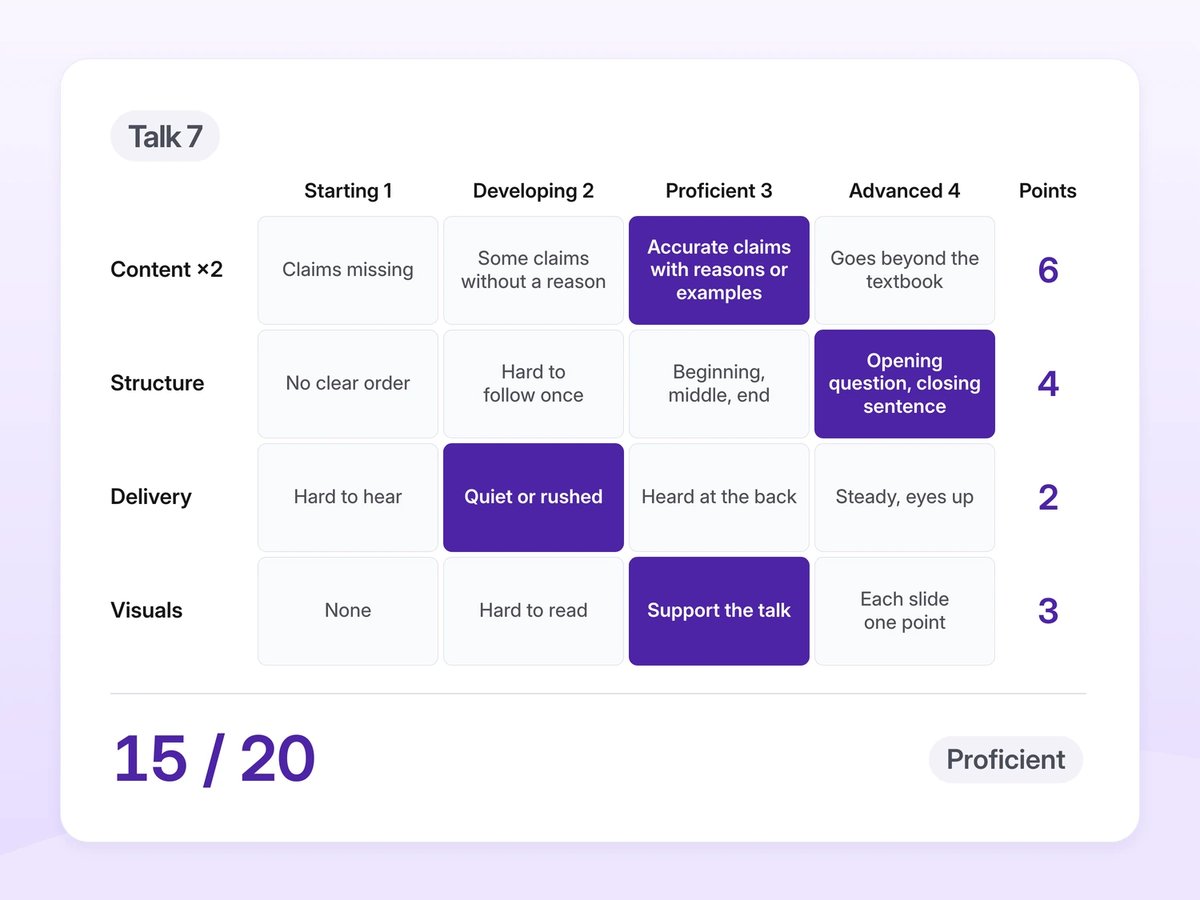
Talk 7: 15 of 20, Proficient
Talk 7 lands in Proficient, but the useful part is not the 15. It is the Developing in Delivery: practice with a card of keywords instead of full sentences. Another talk with four Proficient rows also scores 15, so a total cannot tell the student which skill to work on; the row you chose can. Turning 15 out of 20 into a letter grade is up to your school's grading system; the rubric supplies the evidence for it.
Rubric examples for other assignments
The oral presentation rubric is one pattern. The criteria change with the task, the method stays. Here are starting criteria, three to six per assignment, that you can describe at the same four levels.
Here is the argumentative essay rubric one step further, with the two levels teachers most often have to tell apart.
Turn a rubric into a scoring form in Pollsar
A printed rubric makes you add points by hand and retype the same comment thirty times. In Pollsar the rubric becomes a rubric grader: a short form you fill in for each talk. It adds the points for you and shows the matching comment the moment you finish. Describe the assignment to the AI assistant in the survey maker and it drafts the questions with their points, or build it yourself. Each criterion is a question whose four levels are answer options, a rule on every option adds its points to a variable, with 2, 4, 6 and 8 for the doubled Content, and four final pages, one per range, show the comment and the score.
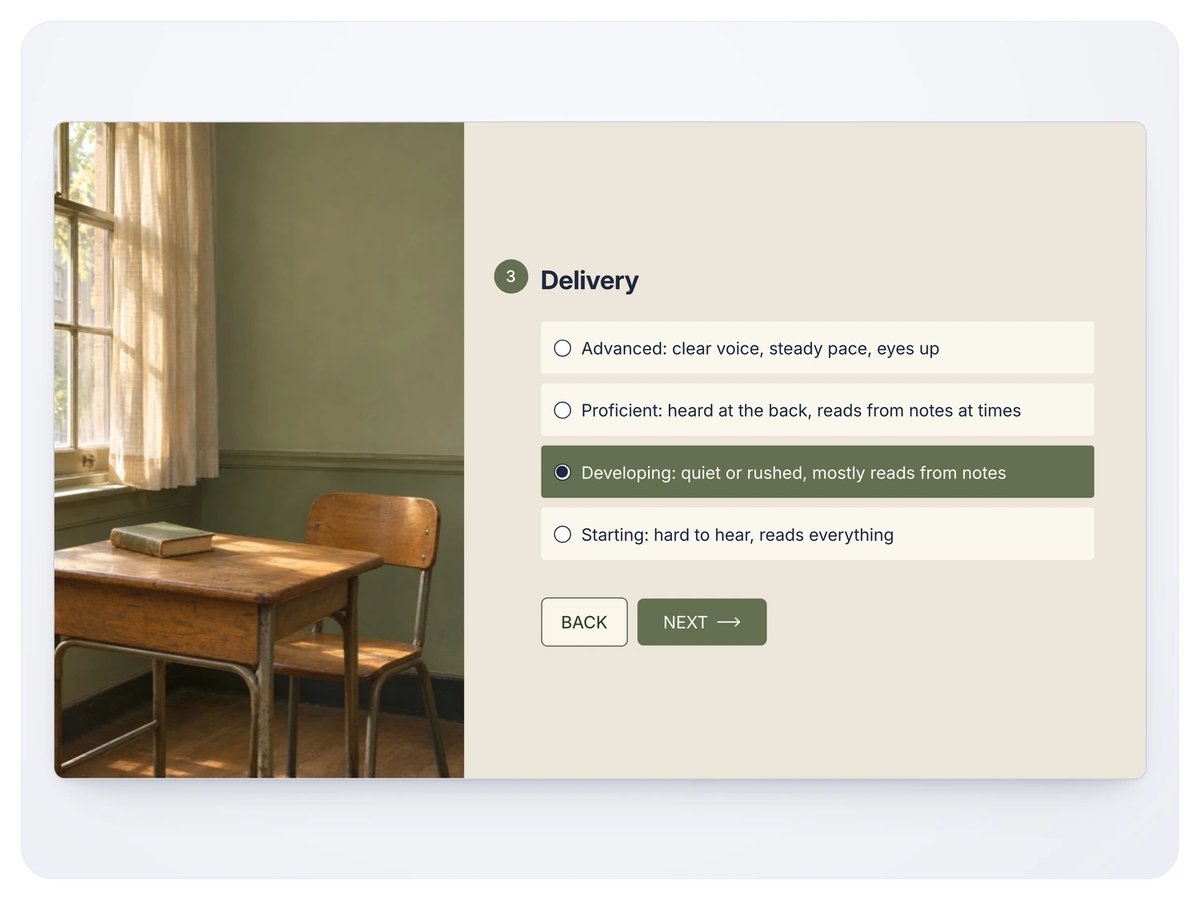
One criterion, four levels: you tap the level you heard
For an under-16 class, enter only the four criterion ratings online. Read the total and the comment off the final page, write them on the student's paper slip, and give individual feedback during the talk or on paper. What stays online is the class picture: Results shows how many talks landed at each level of each criterion. If 12 of 28 talks sit at Developing for Delivery, the next lesson is on delivery, not on content. The scoring form asks for no names or other personal details, and it does not need them.
The same rubric works for the students. Give the link or QR code to the class for self-assessment and they answer without names; you see the class picture, not who answered what. Used while the work is still in progress, this is formative assessment in its simplest form. Scoring each other's talks with one shared form is a peer assessment, a topic of its own. A single-point rubric becomes a form with two text fields per criterion and needs no points.
Advantages and disadvantages of rubrics
Rubrics get praised more often than examined. Here are the benefits of using rubrics and what they cost, with a fix for each cost.
Rubric questions
What is a rubric vs a matrix?
A rubric is a scoring guide; a matrix is a grid of rows and columns. A rubric is usually drawn as a matrix, with criteria in rows and levels in columns, which is why the two words get mixed up. A matrix of facts with no levels or descriptions is not a rubric.
What are the four types of rubrics?
Most lists name analytic, holistic, single-point and the checklist. Some university guides replace single-point with a developmental rubric: an analytic rubric whose levels describe growth over time instead of a grade for one task.
What makes a good rubric?
Three to five criteria that serve the goal of the task, descriptors that name what you can see or hear, a top level about better thinking and not more length, and a test on two or three old pieces of work before students see it.
What is a rubric in AI?
It is the same idea applied to machine answers: a list of criteria with levels that a person, or another model, uses to score an AI answer. The criteria might be accuracy, completeness and tone.
Can I make a rubric for free?
Yes. A rubric is criteria and descriptions, and the oral presentation rubric above is yours to copy onto paper or into a document. A single-point rubric also works as an online form with two comment fields per criterion, and you can start it free in Pollsar.
Build your rubric as a form
Pick one assignment, write the Proficient level first and test the rubric on an old piece of work. When the descriptors hold, describe the assignment to the AI assistant in the survey maker, and you get a link you can open at the next talk. More ideas for the classroom are on the Pollsar page for teachers. You can start free, no credit card.