Educational Games for Kids: Pick by Age and See What Your Child Can Do
Educational games for kids are games where the child has to use a skill to win: counting, reading, sorting, planning, remembering. A game that only keeps a child busy is a pastime, however many letters flash on the screen. The test is simple: take the skill away and the game stops working.
Below are games for ages 2 to 5, 6 to 8 and 9 to 12, free online and no-screen options, a short safety check for online games, named free games, each checked for ads and sign-up, and a step parents and teachers rarely take: a five-question round before and after a week of play that shows what the child can do.
How to choose an educational game in four questions
Lists of the best educational games for kids sort by subject. A child's day sorts differently, so start with the questions below and the list narrows by itself.
- What skill should the game use? Name one: making change, spelling a word, telling a cause from an effect. A game with three skills at once usually teaches none of them.
- Can the child win by guessing? If tapping at random reaches the next level, the game rewards speed, not learning. Look for rounds where a wrong answer changes what happens next.
- How long is one round? Five to ten minutes is a practical length for most children under 9. A long round with no natural stop is where arguments about turning it off start.
- What does it ask of the child? A name, an email or a chat with strangers is a reason to walk away, free or not.
Then match the game to the child. A four-year-old and an eleven-year-old can enjoy the same ball game and learn from it in completely different ways, so the rest of the guide goes by age.
Educational games for kids ages 2 to 5
At this age the best educational games are physical and happen with an adult beside the child. Rules are one sentence long, a round lasts a few minutes, and the adult does the reading. Free preschool learning games do not need a screen at all.
- Farm sort. Put toy animals, or pictures cut from a magazine, on the table. Ask for all the animals with four legs, then all the animals that live in the barn. Skill: sorting by one feature, then by another. Make it harder by sorting twice.
- Count and fetch. Say a number up to five and the child brings that many spoons. Skill: counting objects, not reciting numbers. Swap roles, and let the child give you a number to fetch.
- Shape hunt. Find three round things in the room, then three square ones. Skill: naming shapes in real objects.
- Sound snap. Say two words and the child claps if they start with the same sound: sun, sock yes, sun, moon no. Skill: hearing the first sound, the foundation of reading.
For a free online game for a toddler, sit next to the child and look for the same signs: one idea per screen, no timer that rushes, no pop-ups. A kids farm game that asks the child to feed three sheep and count them is educational. One that only makes animal noises when tapped is a toy. Three free places, each opened and checked for cost, ads and sign-up:
- Bubble Pop with Curious George on PBS KIDS. For preschoolers: the child counts bathtub bubbles one by one. You play without an account. Sponsor messages can appear on PBS KIDS, so stay beside the child. Skill: counting. Adult action: count each bubble aloud, then ask your child to bring you the same number of spoons.
- Starfall. Its Learn-to-Read program is free and the site has no ads; other grades and subjects need a paid membership. Skill: letters and early reading. Adult action: after one letter page, ask your child to find that letter on a cereal box.
- Sheppard Software. Hundreds of free online learning games; its recommended section for preschool and kindergarten covers numbers, colors, shapes, the alphabet and animals. The pages carry ads, so stay beside the child. Skill: matching and early counting. Adult action: after a shapes game, hunt for that shape around the room.
Educational games for 6 to 8 year olds
Children of this age read short sentences, add and subtract small numbers and love rules. Scores start to make sense here: a child can see the points and work out why they got them. The games below work at home or at a small table, with no devices.
- Shop. Price ordinary objects from 5 to 90 cents. One child is the shopkeeper, one pays with play coins and the shopkeeper counts back the change. Skill: adding, subtracting, change. This is an educational money game in its simplest form.
- Word ladder. Change one letter to make a new word: cat, cot, dot, dog. The first player who cannot move loses the round. Skill: spelling and sounds.
- Mystery object. One child hides a picture and answers only yes or no to questions. Skill: asking narrowing questions, the foundation of reasoning.
- Memory pairs. Eight pairs of cards, face down, matching a word to a picture. Skill: attention and recall, plus reading if the cards carry words.
For online play at this age, the useful types are puzzle games where a picture appears piece by piece, simulation games, where the child runs a small shop or garden and sees how choices change the result, and falling-block games such as Tetris, which ask the child to turn and fit shapes. A game that lets a child win by guessing teaches guessing, so pick one where a wrong move shows. Four places, checked the same way:
- Addition Fruit Splat on Sheppard Software. Free, with ads on the page: an arcade-style addition game with 7 levels. Skill: adding small numbers. Adult action: ask the child to say each sum aloud before clicking.
- Math Playground. A math site for kindergarten to grade 6. Free, with ads that are aimed at children and not personalized; the paid premium section is optional. Skill: practice by grade. Adult action: open the page for your child's grade and agree to play one game, then stop.
- Starfall Learn to Read. The free Learn-to-Read program from the list above goes on past letters into phonics, fluency and comprehension, so it still fits a 6-year-old. Skill: sounding out words. Adult action: after one activity, ask your child to read you one short sentence from it with the pictures covered.
- Times Table Duck, for the older end of this group. The child solves multiplication equations in the right order and escapes in 15 seconds or less; its page ties it to grades 3 and 4. Skill: mental multiplication. Adult action: note which table slowed your child down, then practice that table on paper for five minutes.
Educational games for kids 9 to 12, including 11 and 12 year olds
Parents of children this age ask what games a 12 year old should play, or what the best game for an 11 year old is. The honest answer starts with a type; the titles follow below. Children from 9 to 12 want a goal they chose, a score they can beat and something they can show to a friend. Educational video games and computer games fit this age when the learning is the way to win and not a quiz stapled to the end.
- Role-playing games. The child plays a shopkeeper, a doctor, a ship's navigator or a city planner and makes decisions with facts. Offline, a family can run it at the table: one player is a ship's navigator with fuel for the short route through a storm or the long one around it, never both.
- Physics games. Build a ramp or a bridge and watch it fail or work. The child learns by revising the design, which is the real method of engineering.
- Strategy and food games. Run a bakery for a week: buy flour, set a price, sell out or waste. Skill: budgets, ratios and cause and effect. The offline twin is scaling a recipe from four servings to six.
- Word and logic puzzles. Crosswords, code-breaking and sequence puzzles. A short daily puzzle beats a long weekend one.
- Scratch. A place to make a game instead of playing one, free for everyone. Set up the account yourself and keep the child's real name out of it. Skill: sequencing and logic. Adult action: ask your child what happens in the game if one block moves, and let them show you.
- PhET Balancing Act. A physics simulation on levers and balance. Free for all students and teachers, from the University of Colorado Boulder. Skill: reasoning about cause and effect. Adult action: ask your child to predict where a weight must go before moving it.
- Explore Mars: A Mars Rover Game on NASA Space Place. The child picks a rock on Mars, sends the rover a sequence of commands to reach it and analyze it, and earns points for each new rock. Skill: planning a sequence of steps. Adult action: before the rover moves, ask which command comes next and why.
- Mix & Move with AI. A free Hour of Code activity of about an hour, listed for ages 8 to 18: the child designs a dancer and codes a music remix. Skill: sequencing steps. Adult action: sit beside the child and ask what the next step will do before each click.
- Word and brain games on Sheppard Software. Free language arts and brain games, with ads on the pages. Skill: spelling and logic. Adult action: agree on a ten-minute limit and ask for one new word at the end.
Educational games for students of this age work best in a group of four: one player reads the rules, one handles the money, one checks the arithmetic, one records. Rotate the roles each round. For a whole class, the guide to classroom games covers the offline versions.
Fun educational games for kids at home, with no screen
Home is where a game has to compete with a phone, so it should start in a minute. Choose by what you have nearby: paper and a pencil for Story Chain, a kitchen scale for estimation, or a coin for Map Race.
- Kitchen scale. Guess the weight of three foods, then weigh them. The one closest wins. Skill: estimating, units.
- Story chain. Each person adds one sentence, and the next person has to use the last word of the previous one. Skill: vocabulary and listening.
- Map race. Draw a simple map of the street. One player hides a coin, the other finds it from four directions: two steps left. Skill: directions, left and right, counting.
- Pocket health check. Each family member picks one habit for the week, such as a glass of water at breakfast, and checks it off on a paper chart. Skill: planning and noticing, and a small health habit, tracked on paper only.
Free online educational games for kids: what to check first
Free online educational games for kids, like educational digital games of any kind, are plentiful, and the quality is uneven. Two minutes of checking before the child plays saves an evening of cleaning up afterward. Open the game with the sound on, as a 4-year-old or an 8-year-old would meet it.
- Does it ask for a name, email or date of birth before the first level? If the first level requires personal details, choose a game your child can play without entering them.
- Are there ads or links out? An ad for a different game in the middle of a counting round is a sign the game exists for the ad.
- Is there a chat or a way to share photos? For young children the answer should be no.
- Is the purchase button within the child's reach? Free often means free to start. Try the first ten minutes yourself.
- Does it stop? A round with an end beats an endless collection of stars.
Online games for kids that run in the browser need no download, so there is nothing to install. That makes them an easy first try. Games that need installing, accounts or a payment are better for later, once you know the child sticks with them.

Not every game must be educational
Non-educational games for kids are fine too. The games that are both educational and fun are the ones where the fun is the skill, like the shop game. A child who plays only for learning learns that play is work. A good balance is one game with a clear skill and one that is only fun, picked by the child. The educational one earns its place by passing the check below.
Educational games for kids to make: a game and a check in ten minutes
You do not need a programmer to make an educational game. The simplest way is a quiz round that goes with a game the child already plays: the child plays the shop game on the carpet, then answers five questions on a phone. The questions are the game's second half, not a test: they show what your child can do now and what to play next.
Say you teach 8-year-olds, or you are a parent of one. Before the first shop game, try one purchase together and watch how your child counts back the change. Play shop for a week, then change the price and ask again, this time without help. For a class, or for a record you can compare, build this round as a quiz and run it twice: before the first game and after a week. After the first run, note how many children got each question right, and set the second run next to those numbers. Five questions have points, one per right answer. A sixth asks what was hardest and has no points.
- 1. A pencil costs 35 cents. You pay with 50 cents. How much change do you get? 10 cents, 15 cents, 25 cents, 85 cents. Right: 15.
- 2. Two stickers cost 20 cents each. How much do they cost together? 20, 22, 40, 60 cents. Right: 40.
- 3. A ruler costs 55 cents and an eraser costs 40 cents. You have 1 dollar. Can you buy both? Yes, and I have 5 cents left; Yes, and I have 15 cents left; No, they cost more than 1 dollar; Only if I find 5 more cents. Right: yes, 5 cents left.
- 4. Which US coins make exactly 30 cents? 3 nickels; 2 dimes; 1 quarter and 1 nickel; 1 quarter and 1 dime. Right: a quarter and a nickel.
- 5. You pay 1 dollar for a snack that costs 75 cents. How much change do you get? 15, 25, 35, 175 cents. Right: 25.
- 6. Which part of the shop game was hardest? Adding the prices, working out the change, counting coins, none of them. No points.
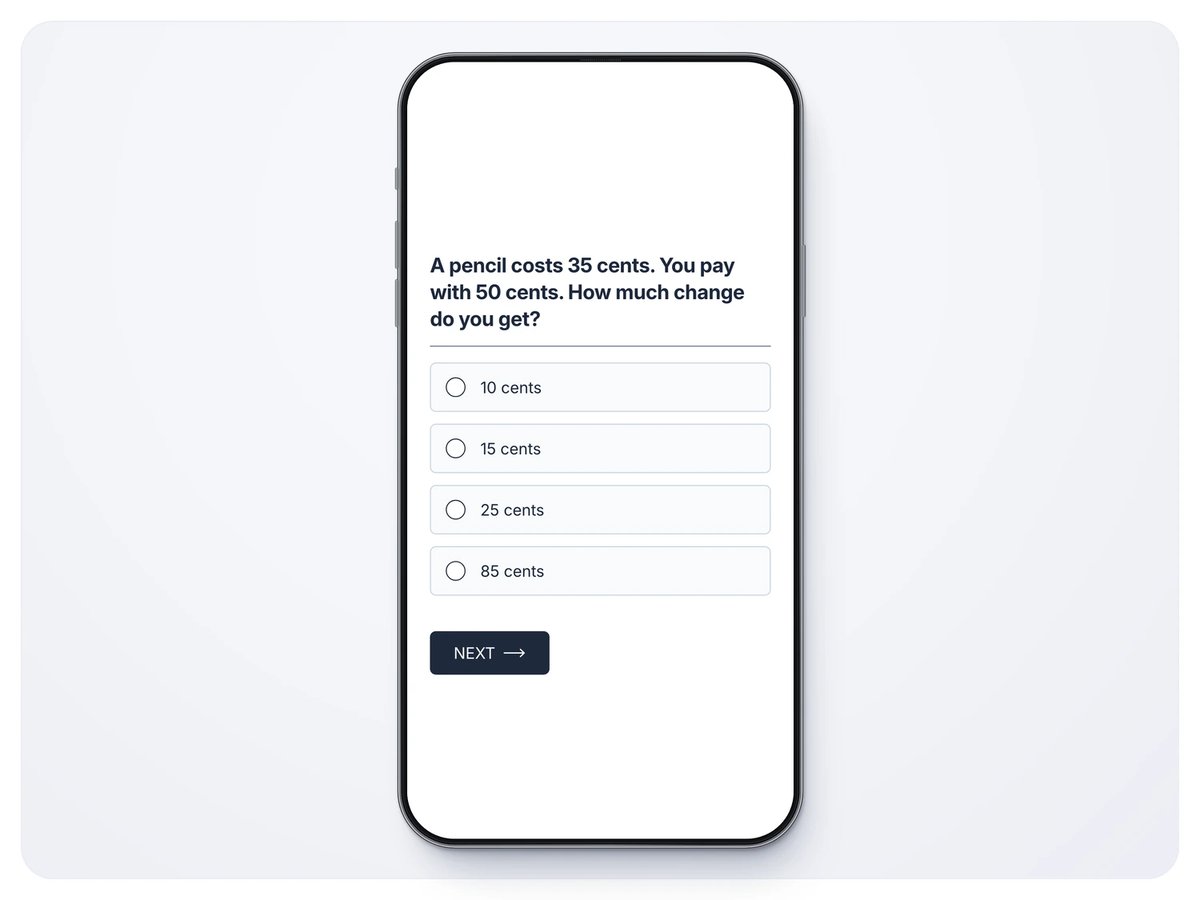
One question, one screen: a child reads it and taps an answer
Three final pages open by score. A score of 0 to 2 opens Back to the shop: let's play with change from 50 cents. A score of 3 or 4 opens Nearly there: choose one purchase and show how you counted the change. A score of 5 opens Shopkeeper of the week. To build it fast, describe it to the AI assistant: Write five scored questions about shopping with US coins for 8-year-olds. Give one point per correct answer. Add a sixth, unscored question asking what felt hardest. Then add the three final pages in the builder.
The final page for the top range
The child opens the quiz from a link or a QR code on the whiteboard or the fridge, with no account. Leave out names, email addresses and other personal details. Results shows the score of every response and, question by question, how many children chose each answer.
What to change in the game after the round
A single score cannot say which skill is missing, so read the answers to each question. Say 20 children took the round before the first shop game and again after a week.
- Question 5 right for 6 of 20 before the game and 8 of 20 after a week: change from a dollar is the gap. Add a round where every customer pays with a dollar.
- Question 4 right for 18 of 20 both times: coins were never the problem, so drop the coin counting and spend the time on change.
- Question 6, most children choose working out the change: this agrees with question 5, so you can trust the signal.
- Four responses score 0 to 2 even after a week: you do not know whose they are, and you do not need to. Their final page already sent those children back to change from 50 cents, so set up a table for adding prices up to 50 and invite anyone who got that page.
The same logic works for a reading game with five questions on the words used, a science game on cause and effect or a map game. A short round, a score and a next step is also the idea behind formative assessment.
Educational games for kids: common questions
What are some free online games for toddlers?
Two free places to start are Bubble Pop on PBS KIDS, where the child counts bubbles, and the letter pages on Starfall. Choose games with one idea per screen and play together. For the youngest, playing with real objects next to an adult comes first. If the game asks for personal details, choose another one.
What games are educational and fun?
The ones where the fun is the skill. Shop is fun because the child wants to hand back the right change, Word ladder because the next word is a small puzzle, a physics game because the bridge falls down. If a game stays just as fun after you take the learning out, the learning was decoration.
What games should 12 year olds play?
Games with a goal the child sets: building and physics games, strategy and business games, word and logic puzzles, and role-playing games where decisions use facts. Look for games where a failed attempt shows what to change. Scratch is a free place to build one.
What is the best educational game for an 11 year old?
There is no best title, only a best fit for one skill. Name the skill, pick a game that uses it in every round, then run a short quiz before and after a week of play. If the answers improve, keep the game. If not, change it.
Are there educational games for kids with ADHD?
Short rounds, a clear goal, quick feedback and few distractions on the screen tend to suit children who find it hard to stay focused. An offline round timed on a kitchen clock works the same way. Talk to the child's teacher or doctor about what suits this child.
Can I make an educational game for kids myself?
Yes. A quiz round with points is a game the child can replay. Write five questions from the rules of the game your child already plays, send the link and see the first scores the same day.
The next shop round
For the next shop round, change one price and let the child explain how much change the customer gets. For a whole class, describe the five questions to the AI assistant in the Pollsar quiz maker: it builds the round with the points, you add the three final pages, and the children open it from a QR code with no account.